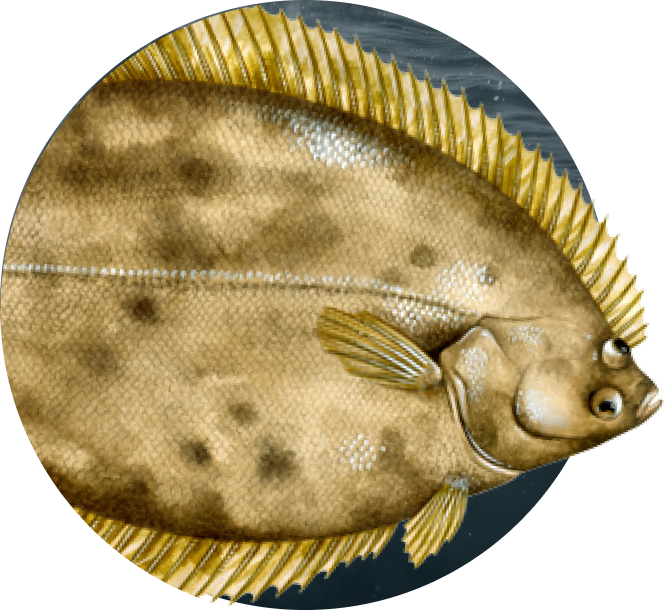
Arlington, VA – The Commission’s Winter Flounder Management Board reviewed the results of the Northeast Fisheries Science Center’s (NEFSC) management track stock assessments* for the Gulf of Maine (GOM) and Southern New England/Mid-Atlantic (SNE/MA) winter flounder stocks. These assessments found GOM winter flounder is not experiencing overfishing while the SNE/MA winter flounder stock is not overfished nor experiencing overfishing. The overfished status for the GOM stock remains unknown. The management track assessments for both stocks include data through 2021.
SNE/MA winter flounder experienced a change in stock status from overfished to not overfished due to a change in the years of recruitment estimates used to estimate biological reference points. Instead of drawing upon the entire time series of recruitment estimates, the projections now only use recruitment estimates from the past 20 years (2002-2021). The SNE/MA winter flounder stock is most likely not capable of achieving the high levels of recruitment that were observed prior to 2000 due to changes in environmental conditions; therefore, using a truncated recruitment time series of only the past 20 years better reflects current stock condition. However, despite a change in stock status; trends in survey indices and model estimates all continue to indicate the SNE/MA stock is in poor condition.
The GOM stock uses a modeling method that incorporates survey indices of abundance to obtain area-swept biomass and exploitation estimates. There have been time series lows in fishery removals (harvest and discards) for GOM winter flounder in recent years. Overall, the indices of abundance have not responded positively to the large declines in commercial and recreational removals since the 1980s. However, there were increases in the fall 2021 and spring 2021 and 2022 area-swept biomass estimates, which, if they continue, could be the beginning of a response to continued low fishery removals. It should be noted, however, that no survey data is available for 2020 due to the COVID pandemic, which is a source of uncertainty in this area-swept assessment that relies on survey data.
Given this information, specifications recommended by New England Fishery Management Council, and recommendations from the Technical Committee and Advisory Panel, the Board maintained 2023 recreational and commercial measures for the GOM and SNE/MA winter flounder stocks for the 2024-2025 fishing years (see Table 1).
Table 1. 2024-2025 Winter Flounder Commercial and Recreational Measures for Gulf of Maine and Southern New England/Mid-Atlantic Stocks.
| Stock | Sector | Trip Limit/ | Size Limit | Season | Gear |
| Possession Limit | |||||
| GOM | Commercial | 500 lbs/ trip/day | 12” | Maintain closures | Minimum 6.5” square or diamond mesh in cod-end. |
| Recreational | 8 fish | 12″ | Open all year | ||
| SNE/MA | Commercial | 50 lbs/38 fish/trip/day | 12” | Maintain closures | Minimum 6.5” square or diamond mesh in cod-end. 100-lb mesh trigger. |
| Recreational | 2 fish | 12” | Maintain closures |
The next management track assessments for both stocks are scheduled for 2024, and the next research track assessment, the equivalent of the Commission’s benchmark stock assessments, are scheduled for both stocks in 2026. As part of this analysis, the NEFSC will attempt to incorporate climate data into the SNE/MA winter flounder stock assessment. The management track assessment reports for GOM and SNE/MA winter flounder are available on the Commission’s website at http://www.asmfc.org/species/winter-flounder under Stock Assessment Reports. An overview of the assessment is available here. It was developed to aid media and interested stakeholders in better understanding the assessment results.
For more information, please contact Tracey Bauer, Fishery Management Plan Coordinator, at tbauer@asmfc.org.