Atlantic Herring
Latest News and Resources
-
Season 2 Days Out Measures for the 2026 Atlantic Herring Area 1A Fishery
-
Atlantic Herring Western Maine and Massachusetts/New Hampshire Spawning Closures in Effect Starting September 23, 2026 through November 3, 2026
-
2026 Annual Meeting Preliminary Agenda
-
2026 Annual Meeting Travel Authorization
-
Atlantic Herring Area 1A Days Out Meeting Scheduled for September 21
-
Atlantic Herring Eastern Maine Spawning Closure in Effect Starting August 28, 2026 through October 8, 2026
-

Population Abundance
Overfished
Fishing Mortality
Overfishing not occurring
Current Status
Stock status based on 2026 assessment update. Spawning stock biomass at 19% of target. Restrictive management measures in place.
-
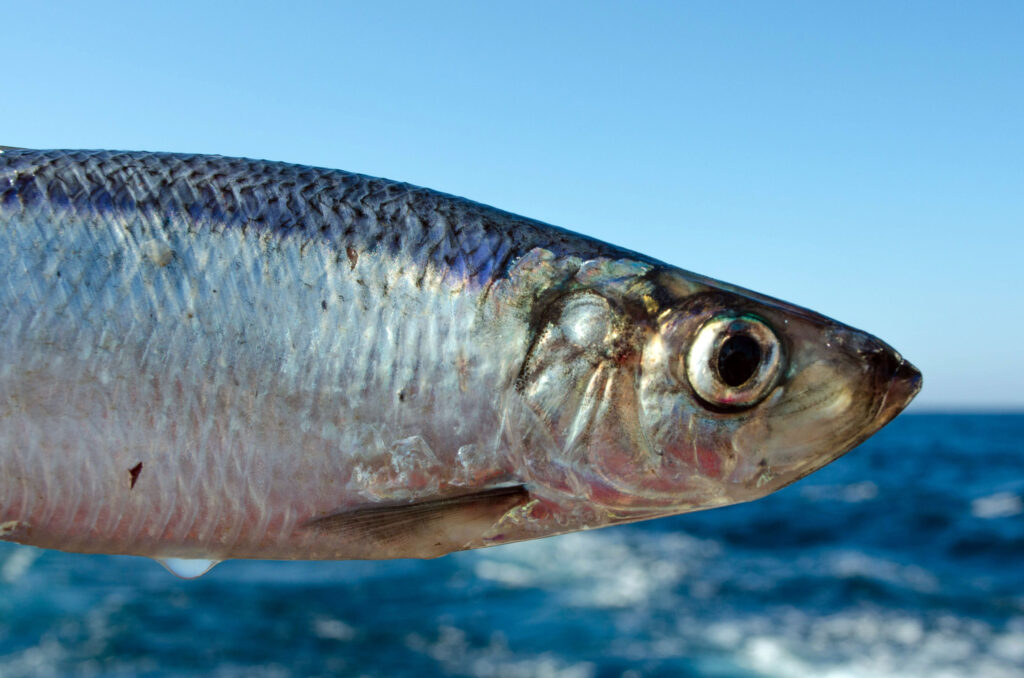
Credit: ASMFC -
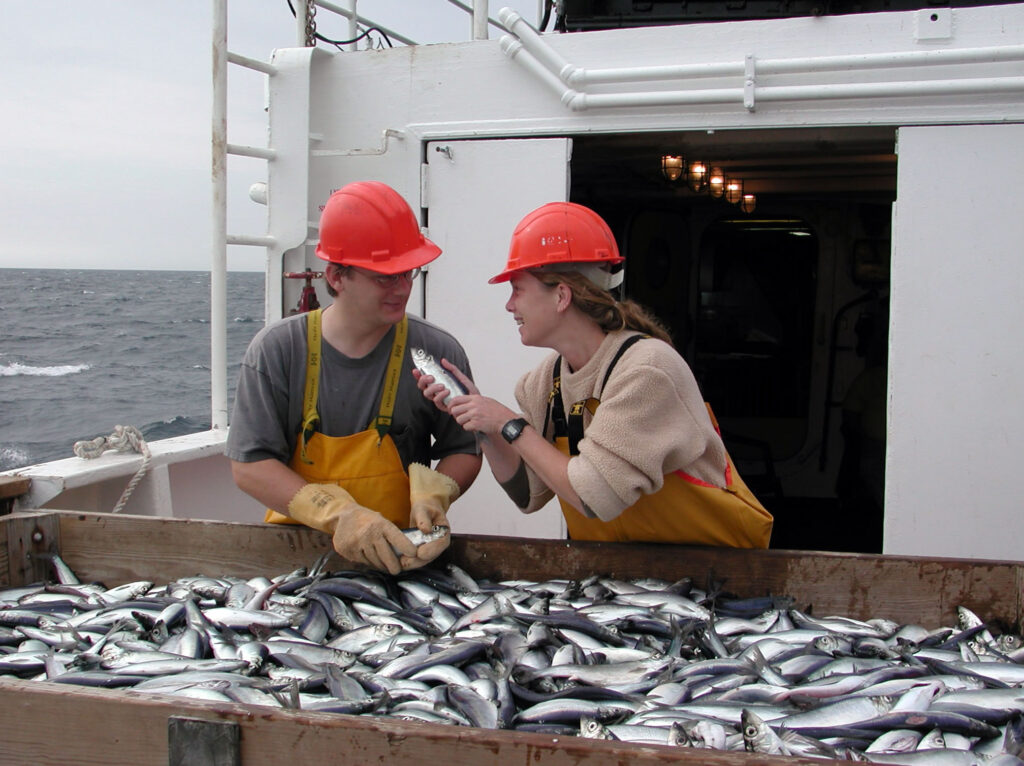
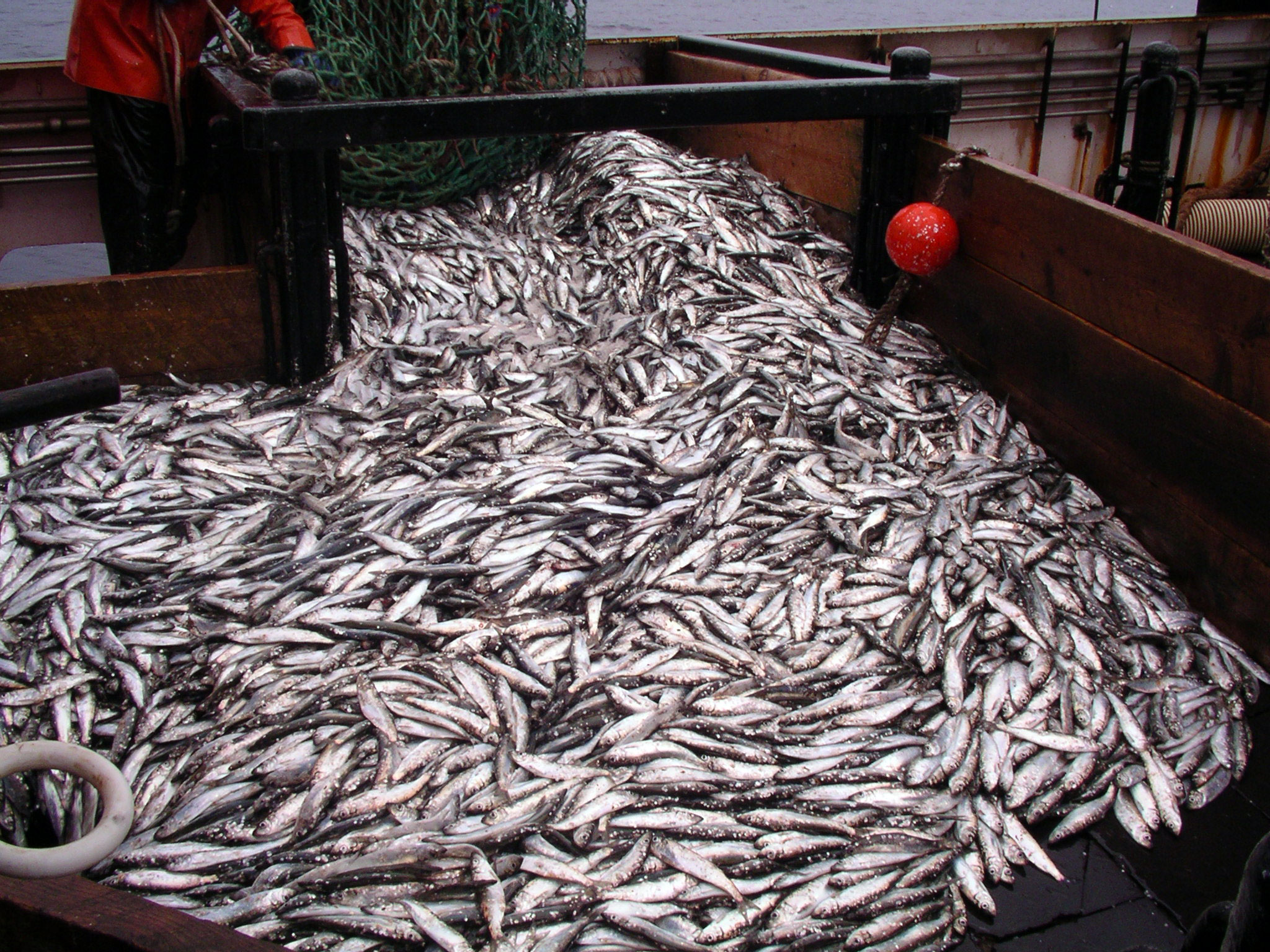
Herring catch. Credit: NEFSC Pelagic Trawl Survey -
-
-
Credit: Kohl Kanwit, Maine Department of Marine Resources -
-
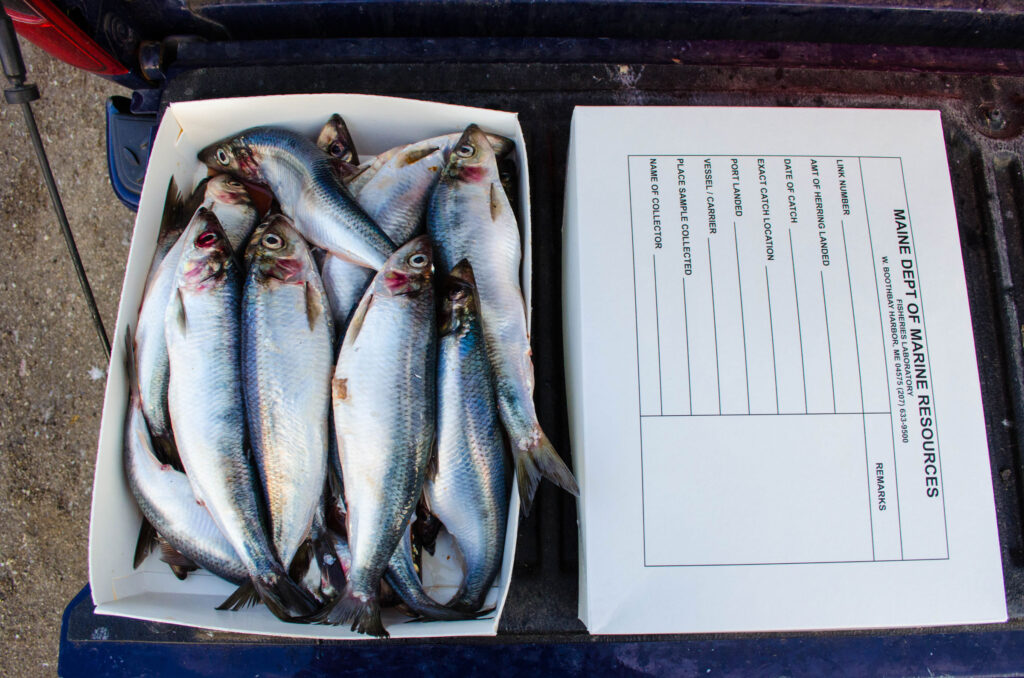
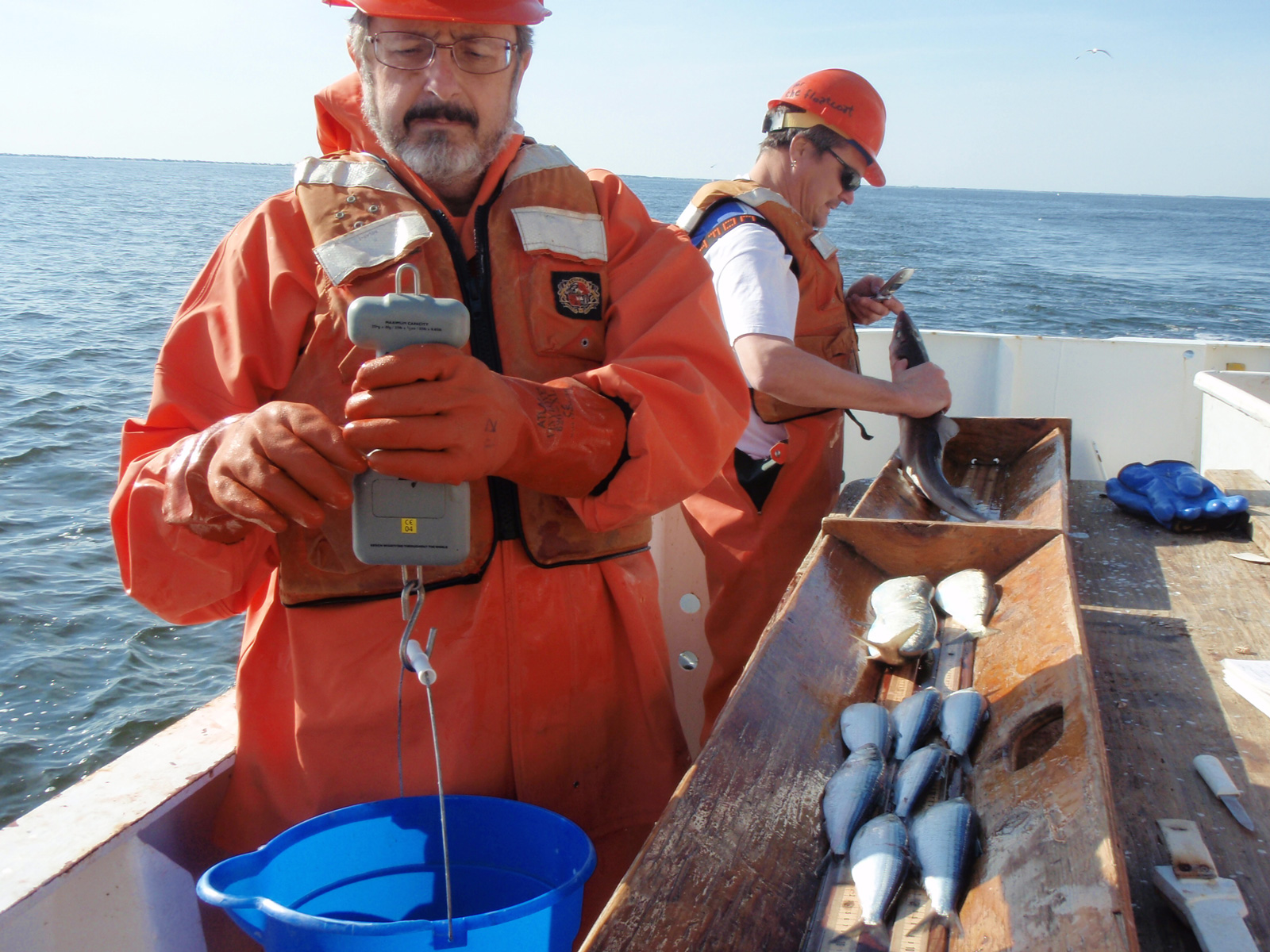
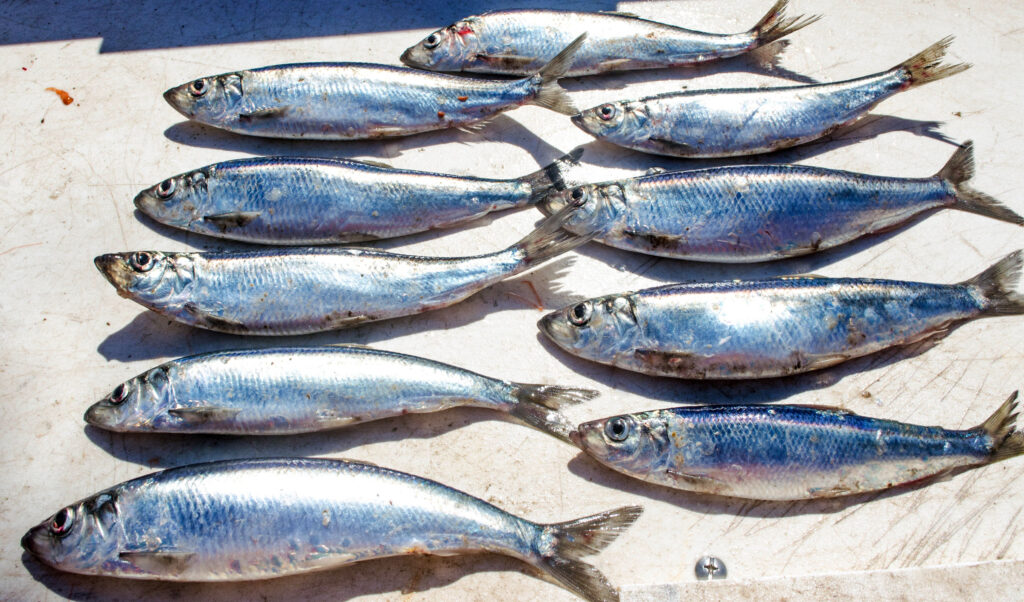
Catch at age sample -
-

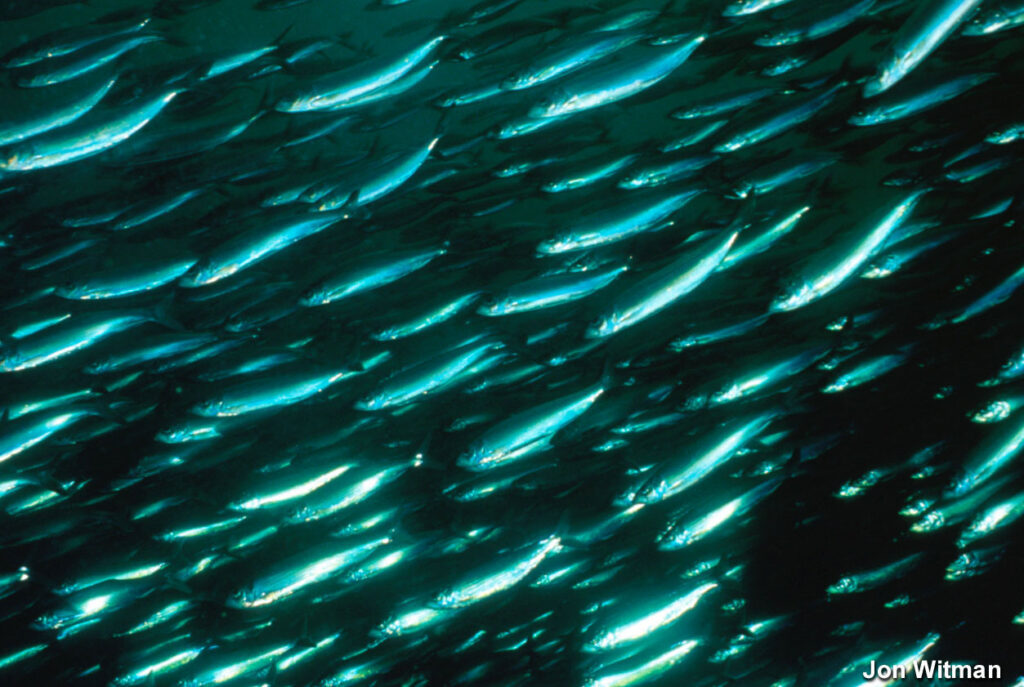
Herring catch in 2001. Credit: NEFSC Pelagic Trawl Survey -
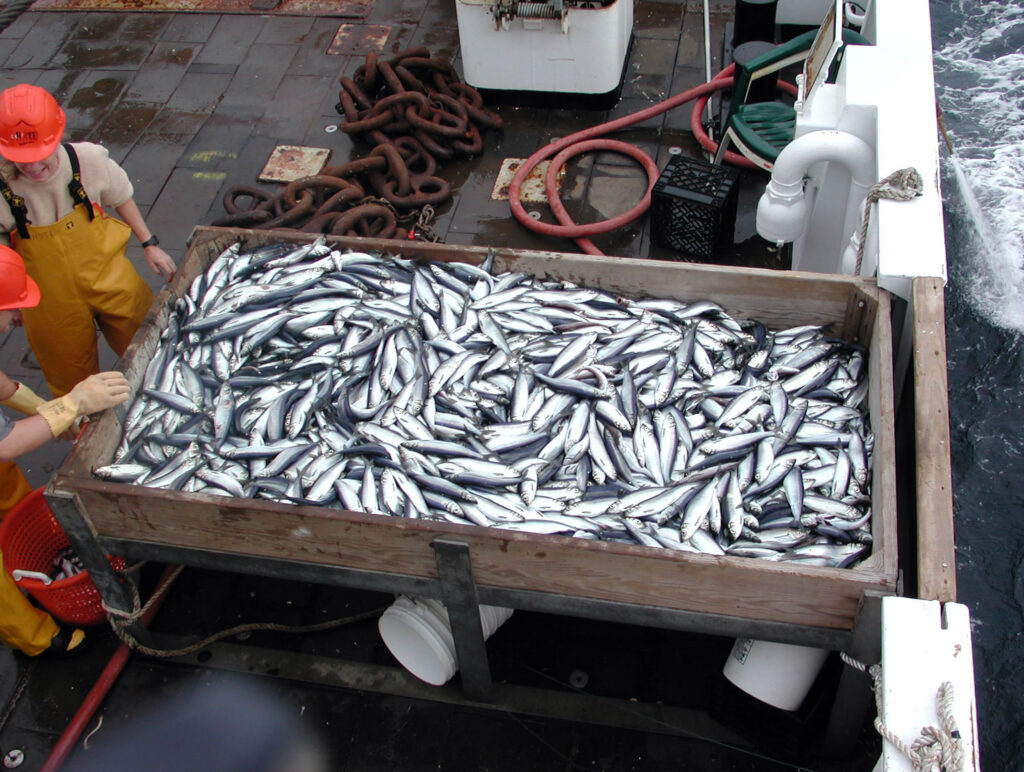
September 2000 herring catch. Credit: NEFSC Pelagic Trawl Survey
Meeting Calendar
Next Meeting
Contacts
- Emilie Franke, FMP Coordinator (EFranke@asmfc.org)
- Management Board, Doug Grout, Chair
- Technical Committee
- Advisory Panel
Species Information
Atlantic herring are a vital species for both the ecosystem and fishing communities, serving as a key forage fish for marine life and supporting important commercial and bait fisheries. Found from Labrador to Virginia, these migratory fish are managed through adaptive measures that balance sustainable harvests with ecosystem needs. From spawning protections to innovative quota systems, Atlantic herring management ensures their role in the marine food web and economic livelihoods remains strong.
Management
The Commission manages Atlantic herring under Amendment 3 to the Interstate Fishery Management Plan, which was approved for management in February 2016 and implemented on June 1, 2016. The Amendment refines the spawning closure system and modifies the fixed gear set-aside. The Amendment consolidates prior amendments (and associated addenda) and recent management decisions into a single document; it is now the comprehensive document for Atlantic herring management in state waters.
Because herring can be found in state and federal waters, there are complementary management plans between the Commission and New England Fishery Management Council (Council) which set annual quotas, called annual catch limits (ACL), for three management areas and two sub-areas. The ACLs for these areas are set based on the maximum sustainable yield that allows for a sustainable harvest but leaves enough herring for fish, birds and marine mammals. While the plans for state and federal waters share management boundaries, there are a few differences between the plans. The Council prohibits mid-water trawling from June 1 – September 30 in Area 1A (inshore Gulf of Maine). The Commission plan includes spawning closures and a “days out” provision. During a spawning closure or a “day out” of the fishery, vessels participating in other fisheries may possess no more than 2,000 pounds of Atlantic herring per trip. In addition, all vessels traveling through Area 1A must have all gear stowed.
In May 2017, the Commission approved the continued use of the GSI-based forecast system to predict when the population will be spawning and when spawning closures should be set based on the development of herring gonads (reproductive organs) in Area 1A. GSI stands for gonadosomatic index, the ratio of the weight of a female herring’s ovaries to her body weight. As female fish get ready to spawn, their ovaries become heavier and the GSI increases. Scientists use the observed rate of increase in the GSI to predict when spawning will occur and when the fishery should be closed.
In April 2019, the Board approved Addendum II to strengthen spawning protections in Area 1A (inshore Gulf of Maine) by initiating a closure when a lower percentage of the population is spawning (from approximately 25% to 20%), and extending the closure for a longer time (from four weeks to six weeks). The Addendum also modifies the trigger level necessary to reclose the fishery, with the fishery reclosing when 20% or more of the sampled herring are mature but have not yet spawned. These changes to spawning protections are in response to the results of the 2018 Benchmark Stock Assessment which showed reduced levels of recruitment and spawning stock biomass over the past five years, including the lowest levels of recruitment on record.
In May 2025, the Board approved specifications for the 2026 fishing year as recommended by the New England Fishery Management Council and later implemented by NOAA Fisheries. The 2026 total ACL is set at 9,134 metric tons (20.1 million pounds). By area, the Area 1A sub-ACL is 2,640 metric tons (5.8 million pounds); Area 1B sub-ACL is 393 metric tons (0.86 million pounds); Area 2 sub-ACL is 2,539 metric tons (5.6 million pounds); and Area 3 sub-ACL is 3,562 metric tons (7.8 million pounds).
Current Days Out Provisions
Days out is the primary effort control measure for the Area 1A fishery. States involved in the Atlantic herring fishery are able to extend the fishery by controlling fishing effort (fishing days) through landing restrictions. The goal is to provide a consistent supply of herring to the market by controlling landings, particularly early in the season when herring may be localized in Area 1A.
Maine, New Hampshire and Massachusetts continue to modify days out of the fishery during the season to prolong the fishery in Area 1A, making herring available during peak demand. The Board established the following seasonal allocations for the 2025 Area 1A sub-ACL: 72.8% available for season 1 (June 1 – September 30) and 27.2% available for season 2 (October 1 – December 31).
The 2026 Area 1A Season 1 days out measures are as follows:
- Landing days will be set at zero (0) from June 1 until the start of the fishery on Sunday, July 19, 2026 at 6:00 p.m.
- Landing days begin on Sunday of each week at 6:00 p.m. starting Sunday, July 19.
- Vessels with an Atlantic herring Limited Access Category A permit that have declared into the Area 1A fishery may land herring five consecutive days a week. The week shall begin at 6:00 p.m. on Sundays and conclude at 6:00 p.m. on Fridays. One landing per 24 hour period. Vessels are prohibited from landing or possessing herring caught from Area 1A during a day out of the fishery.
- Small mesh bottom trawl vessels with an Atlantic herring Limited Access Category C or Open Access D permit that have declared into the fishery may land herring six consecutive days a week. The week shall begin at 6:00 p.m. on Sundays and conclude at 6:00 p.m. on Saturdays.
- Vessels with an Atlantic herring Category A permit may harvest up to 240,000 lbs. (6 trucks) per harvester vessel, per week starting Sunday, July 19, 2026 at 6:00 p.m.
Current Spawning Closure Regulations
The three inshore Atlantic herring spawning areas of eastern Maine, western Maine, and Massachusetts-New Hampshire have independent closures during the fall that may begin on the default dates of August 28, September 23 and September 23, respectively. Actual closure effective dates are determined using the GSI-based forecast system.
This method was developed by the Technical Committee, then tested and evaluated for effectiveness during the 2016 fishing season. The GSI-based spawning monitoring system tracks reproductive maturity to align the timing of spawning area closures with the onset of spawning. The modeling efforts to forecast the spawning closures are available at https://massmarinefisheries.net/herring/
Atlantic Herring Western Maine and Massachusetts/New Hampshire Spawning Closures in Effect Starting September 23, 2026 through November 3, 2026
The 2026 Eastern Maine spawning area will be closed beginning on the default date of August 28 through October 8, 2026.
Stock Status
A 2025 Research Track Assessment was conducted by NOAA’s Northeast Fisheries Science Center and transitioned the stock to the Woods Hole Assessment Model (WHAM). The research track peer review determined that all terms of reference were met and the Board accepted the assessment for management use.
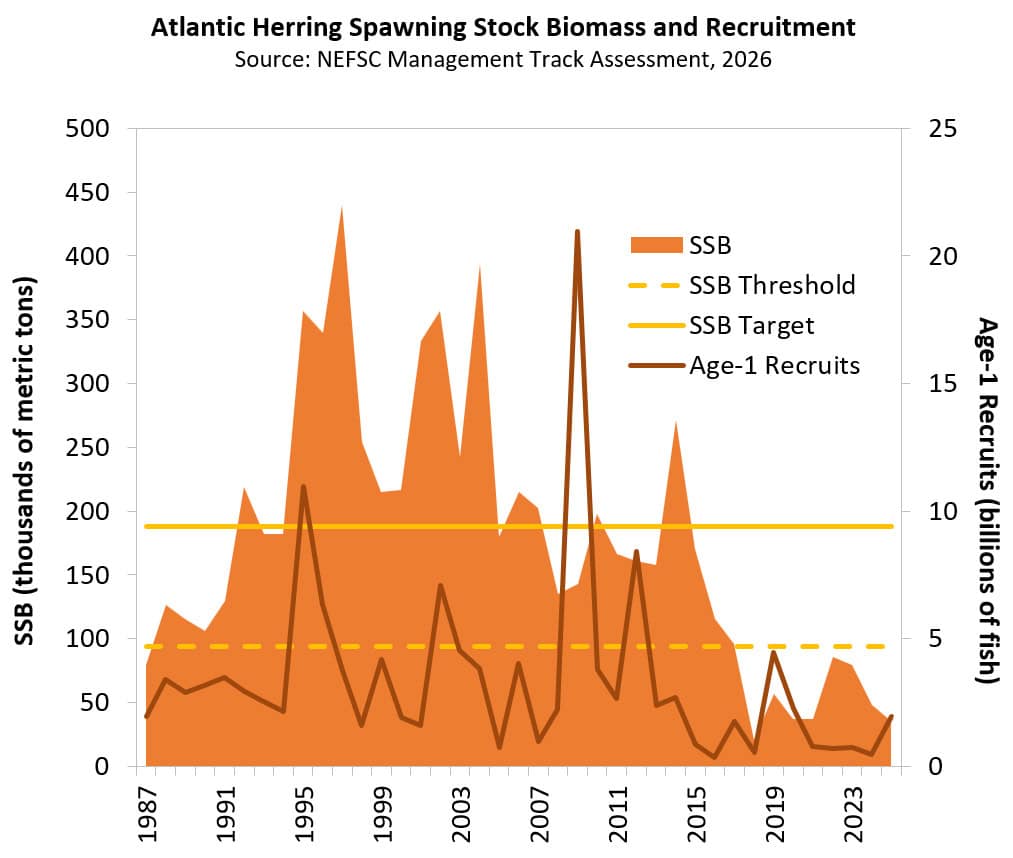
The following 2026 Management Track Stock Assessment then applied the new model to determine stock status and was completed by the Northeast Fisheries Science Center in June 2026. The management track assessment, which includes data through 2025, indicates the Atlantic herring stock is overfished but not experiencing overfishing based on the biological reference points for spawning stock biomass (SSB) and fishing mortality (F). This is the same stock status as determined by the 2024 management track assessment. SSB was estimated to be 35,528 metric tons in 2025, well below the SSB target of 188,214 metric tons. Fishing mortality was estimated to be 0.121 in 2025, also below the overfishing threshold of 0.272. The assessment indicates continued poor recruitment and poor survival in recent years is driving stock status.
The management track peer review found all terms of reference were met except for the projections term of reference, which was considered partially met. Similar to prior assessments, one of the continued concerns is that the projections are overly optimistic.
Commercial & Recreational Fisheries
Atlantic herring are one of the most important species in the Northeast because of the vast role they play in the marine ecosystem and their importance to fishermen.
Herring form the base of the food web as a forage fish for marine mammals, seabirds and many fish throughout the Mid-Atlantic and Northeast. Schooling herring serve as an important prey resource for migrating whale and dolphin populations on which eco-tourism activities, such as whale watching, depend. The herring resource was once primarily used for the canning industry, but now provides bait for important fisheries such as lobster, blue crab, tuna, and striped bass. The fish are also a valued commodity overseas where they are frozen and salted.
The earliest herring fisheries in North America date back 450 years. Today, Atlantic herring is predominantly a commercially-caught species with markets in the US and Canada. The most common gears used to catch Atlantic herring are trawls (midwater and bottom) and purse seines. A small fixed-gear fishery continues primarily in Maine.
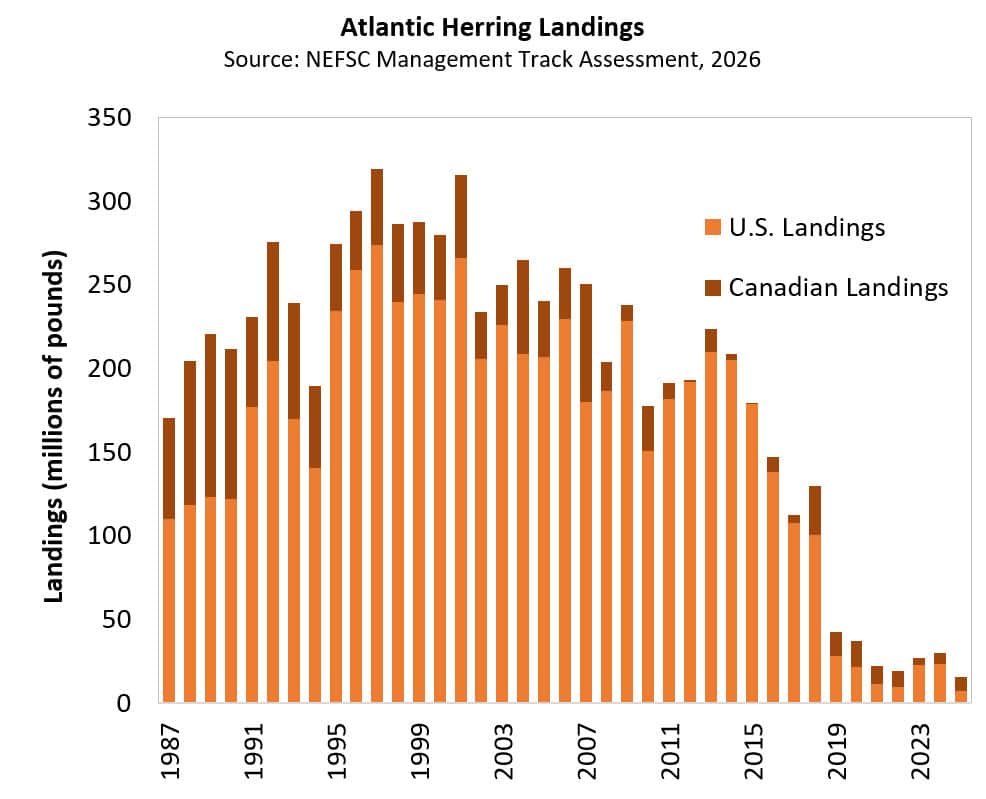
Catch increased in the 1960s, largely due to a foreign fishery which developed on Georges Bank. US commercial landings in the 2000s were fairly stable, ranging between about 130 and 250 million pounds per year. Since 2013, commercial landings have generally decreased and reached the lowest levels the time series in 2021, 2022, and 2025 at 11.5 million pounds, 9.3 million pounds, and 7.2 million pounds, respectively. These low levels in recent years are due largely to reduced quotas in response to stock status.
Life History
Atlantic herring (Clupea harengus) are oceanic, plankton-feeding fish that occur in large schools and inhabit coastal and continental shelf waters from Labrador to Virginia. Juveniles (called sardines) undergo seasonal inshore-offshore migrations. Sardines are abundant in shallow, inshore waters during the warmer months of the year. Adults (age three and older) migrate south from summer and fall spawning grounds in the Gulf of Maine and Georges Bank to spend the winter in Southern New England and the Mid-Atlantic.
Herring spawn as early as August in Nova Scotia and eastern Maine and during October and November in the southern Gulf of Maine, Georges Bank, and Nantucket Shoals. Spawning habitat consists of rock, gravel, or sand bottoms, ranging in depth from 50-150 feet. Females can produce between 30,000 and 200,000 eggs each. Schools can produce so many eggs that the ocean bottom is covered in a dense carpet of eggs several centimeters thick. Eggs hatch in 10-12 days depending on water temperature. By their fourth year, fish are about 10” in length and may grow to about 15” (1 ½ pounds) by 15 to 18 years old. Herring are filter feeders preying entirely on plankton. They usually feed at night following the massive vertical migrations of zooplankton that inhabit deep waters by day and surface waters by night.
News & Resources
Explore recent news, management updates, and scientific reports to gain a deeper understanding of ongoing conservation efforts and sustainability strategies.
-
The Atlantic States Marine Fisheries Commission’s Atlantic Herring Management Board members from Maine, New Hampshire, and Massachusetts met September 21 via webinar to set effort control measures for the 2026 Area 1A fishery for Season 2 (October 1 – December 31). There are approximately 2,075 metric tons (MT) available for harvest during Season 2, which…
-
The Atlantic herring Area 1A (inshore Gulf of Maine) fishery regulations include seasonal spawning closures for portions of state and federal waters in Eastern Maine, Western Maine and Massachusetts/New Hampshire. The Commission’s Atlantic Herring Management Board approved a forecasting method that relies upon at least three samples, each containing at least 25 female herring in…
-
-
-
Atlantic Herring Management Board members from the states of Maine, New Hampshire and the Commonwealth of Massachusetts will meet via webinar on September 21, 2026 from 11:00 a.m. to 12:00 p.m., to discuss Season 2 (October 1 – December 31) days out measures for the 2026 Area 1A fishery (inshore Gulf of Maine). Days out…
-
The Atlantic herring Area 1A (inshore Gulf of Maine) fishery regulations include seasonal spawning closures for portions of state and federal waters in Eastern Maine, Western Maine and Massachusetts/New Hampshire. The Commission’s Atlantic Herring Management Board approved a forecasting method that relies upon at least three samples, each containing at least 25 female herring in…
-
Prepared for the Commissioner Manual
-

This assessment of the Atlantic Herring (Clupea harengus) stock is a management track assessment, and is the first application of the WHAM assessment platform following the 2025 research track assessment (NEFSC 2025). The last management track assessment was in 2024 and was conducted using the ASAP model. Based on that assessment, the stock was overfished…
-
-
A summary of all the board meetings, press releases and motions from the 2026 Summer Meeting.
-
-
-
Combined materials for all Boards convening at the ASMFC Summer Meeting
-
Consider 2025 Research Track and 2026 Management Track Stock; Assessments Action, Presentation of Stock Assessment Reports (J. Deroba), Presentation of Peer Review Panel Reports (J. Deroba), Consider Acceptance of Northeast Fisheries Science Research Track Stock Assessment and Peer Review Report for Management Use; Update from New England Fishery Management Council on Atlantic; Herring Activity (NEFMC…
-
The Atlantic States Marine Fisheries Commission’s Atlantic Herring Management Board members from Maine, New Hampshire, and Massachusetts met via webinar on July 17 to discuss the start date for the 2026 Area 1A (inshore Gulf of Maine) fishery. The Board members previously set the start date for July 19 at 6:00 p.m. as part of…
Get Hooked on ASMFC News
Dive into the latest updates and catch all the important news by joining our newsletter mailing list. Stay in the loop with meeting agendas, fisheries management news, and more.