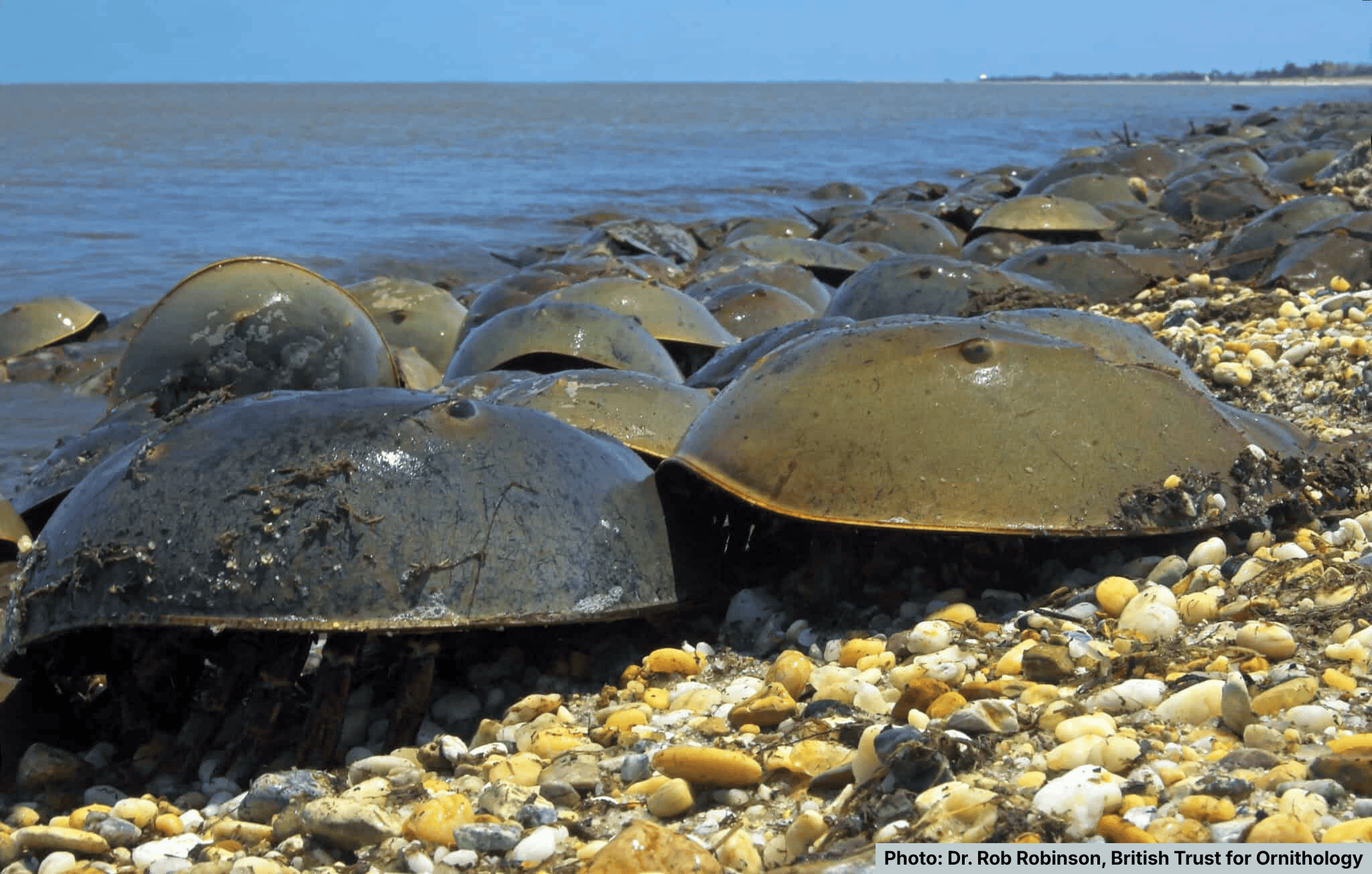
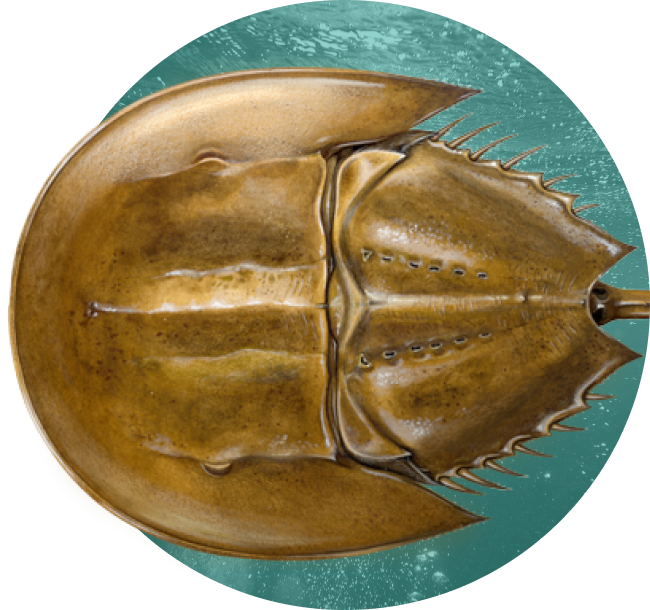
The Atlantic States Marine Fisheries Commission (ASMFC) manages the American horseshoe crab (Limulus polyphemus) along the US East Coast, with most harvest occurring from Massachusetts to Virginia. Horseshoe crabs provide the backdrop for one of the most interesting marine resource management issues along the Atlantic coast due to their multiple human uses and ecosystem values. In addition to their role as a food source for many species, horseshoe crabs provide bait for commercial American eel and conch fisheries along the coast. Their unique blood is also used by the biomedical industry to produce Limulus Amoebocyte Lysate (LAL). The challenge for fisheries managers is to ensure that horseshoe crabs are managed to meet all these diverse needs, while conserving the resource for future generations.
In this document you will find contact information for horseshoe crab related questions as well as the answers to some frequently asked questions.
Contacts
For general media inquiries, contact Tina Berger, Director of Communications, at tberger@asmfc.org.
For questions about horseshoe crab management and science contact Caitlin Starks, Senior Fishery Management Plan Coordinator, at cstarks@asmfc.org.
General information about the management and status of horseshoe crabs can be found on the ASMFC’s species webpage for horseshoe crab. On the webpage, you can also access management documents, stock assessments, and press releases, and general information about ASMFC, our mission, and programs.
The Importance of Horseshoe Crab
How are horseshoe crabs important, ecologically, culturally, and medically?
American horseshoe crabs (Limulus polyphemus) play an important ecological role throughout their range (Maine to Mexico) as part of the marine food web and as a substrate for barnacles and limpets. In different stages of their life cycle, they provide a food source for fish, crabs, conchs, sharks, and sea turtles, including the endangered loggerhead, and they consume many species as well.
Horseshoe crab eggs also play an important ecological role in the food web for migrating shorebirds, some of which are threatened. The Delaware Bay Estuary is the largest staging area for shorebirds in the Atlantic Flyway, where birds stop to rest and feed before continuing their migration. Hundred of thousands of migratory shorebirds converge on Delaware Bay to feed and rebuild energy reserves prior to completing their northward migration.
Additionally, horseshoe crabs have economic value as they support a commercial bait fishery. They are commonly used as bait for eel, whelk, and conch. Horseshoe crabs also support other fisheries as a food source for forage fish and recreationally and commercially important species. In addition, they support the production of Limulus amebocyte lysate (LAL) by the biomedical industry. LAL has significant human health benefits for its use in testing medical products for contamination.
Horseshoe Crab Bait Fishery and its Management
Is there a fishery for horseshoe crabs, and what are harvested horseshoe crabs used for?
Yes, there is a commercial fishery for horseshoe crabs and the ASMFC manages the fishery along the Atlantic coast from Maine to Florida. Horseshoe crabs are primarily harvested commercially as bait for the commercial American eel and whelk/conch fisheries. Trawls, hand harvests, and dredges make up the bulk of commercial horseshoe crab bait landings. For most states, the bait fishery is open year-round. However, because of seasonal horseshoe crab movements (to spawning beaches in the spring; deeper waters and offshore in the winter), the fishery operates at different times.
Annual coastwide horseshoe crab bait landings peaked in 1999 at 2.6 million horseshoe crabs and have since decreased due to the implementation of bait quotas, other fishery restrictions enacted by the states, and reduced demand in the bait market. Bait landings have remained under 1 million horseshoe crabs annually since 2003 and 550,908 horseshoe crabs were landed in 2024.
Horseshoe crabs are also collected by the biomedical industry to support the production of LAL, a product made by harvesting the clotting agents found in horseshoe crab white blood cells (amoebocytes). LAL is used around the world and is a critical product for helping to ensure injectable treatments and implantable devices and equipment are safe from harmful bacteria. The biomedical industry produces LAL by obtaining live, healthy horseshoe crabs, collecting a portion of their blood and extracting the proteins from the white blood cells. Horseshoe crabs used solely for this process are released alive back to their natural environment where they were collected, as required by the fishery management plan. The survival rate for horseshoe crabs used for biomedical purposes is estimated to be 85%. Additionally, horseshoe crabs harvested for bait are sometimes used for LAL production prior to being processed and sold by the bait industry; these crabs are counted against the bait quota. This is a conservation effort allowing crabs destined for the bait market to serve a dual purpose by also being used for LAL production.
How do ASMFC and the states manage horseshoe crabs?
Horseshoe crabs along the US Atlantic coast are managed under the Interstate Fishery Management Plan (FMP) for Horseshoe Crab and its subsequent addenda. The FMP was adopted in 1998 to address concerns about increased exploitation of horseshoe crabs and population impacts.
Under the FMP, each state is allocated a quota for horseshoe crabs harvested for bait. To protect spawning horseshoe crabs in the Delaware Bay region, state waters of Delaware and Maryland (0-3miles from shore) are closed to horseshoe crab harvest and landing from January 1st through June 7th each year, and the landing of horseshoe crabs in Virginia from federal waters (3-200 miles from shore) is prohibited from January 1 through June 7.
Other state horseshoe crab fisheries are regulated with various seasonal or area closures, with many states having implemented more restrictive rules for bait fisheries than what is required by the FMP in recent years. For example, Massachusetts prohibits all harvest during the period of April 16-June 7th, New Jersey and South Carolina do not allow any commercial harvest of horseshoe crabs for bait in state waters, Connecticut recently prohibited hand-harvest of horseshoe crabs, and New York passed a law phasing out commercial and biomedical harvest by 2029. The most recent Fishery Management Plan Review, including current state quotas, can be found here.
Additionally, since 2012, horseshoe crabs harvested for bait in the Delaware Bay region (New Jersey, Delaware, Maryland, and Virginia) have been managed with the use of an Adaptive Resource Management (ARM) Framework to inform the setting of quotas that consider the forage needs of migratory shorebirds, particularly the red knot.
Assessing Horseshoe Crab Populations
How does ASMFC determine the status of the horseshoe crab population? Is it overfished?
The first stock assessment for horseshoe crab was completed and peer-reviewed in 1998. Subsequent stock assessments occurred in 2004, 2009, 2013, 2019, and most recently in 2024. In fisheries, determining stock status means estimating one or more biological characteristics of the stock, such as population abundance (numbers of animals) or biomass (weight), and comparing the estimated values to reference values, such as a level of abundance in the past. Because of limited data to support statistical models and estimate horseshoe crab population characteristics (such as abundance or biomass), no overfishing or overfished definition has been accepted from a stock assessment.
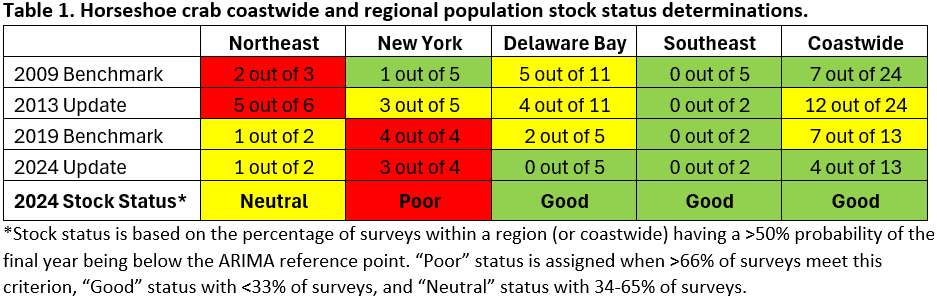
What is available for understanding the trends in the horseshoe crab population are several abundance indices across four regions (Northeast, New York, Delaware Bay, and Southeast). These indices are developed from fishery-independent surveys conducted by state agencies and academic institutions along the Atlantic coast. Most of these surveys do not provide population estimates but rather a sense of the change in abundance over time. The current stock status is based on trend analyses of these survey indices over time, completed during the 2024 assessment update, including data through 2022 (Table 1). The assessment indicates that the Northeast region, which has two surveys with conflicting population trends, is in a neutral state. The horseshoe population in the New York region is poor and has been declining in status from previous assessments. The Delaware Bay region status has improved from neutral to good, and the Southeast region status is good.
The horseshoe crab population of the Delaware Bay region has been estimated, but the population estimate is not used to determine stock status. Male and female horseshoe crab population numbers in the Delaware Bay region are estimated using a model that includes quantifiable sources of mortality (i.e., bait harvest in the Delaware Bay states, coastwide biomedical mortality, and commercial dead discards), natural mortality rates, and abundance indices from the Virginia Tech Trawl Survey, New Jersey Ocean Trawl Survey, and the Delaware Adult Trawl Survey. In the 2024 assessment update, which includes data through 2022, the Delaware Bay populations were estimated at approximately 40 million mature male and 16 mature female horseshoe crabs.
An overview of the 2024 assessment update can be found here.
What is the Virginia Tech Trawl Survey and how is it used by the ASMFC?
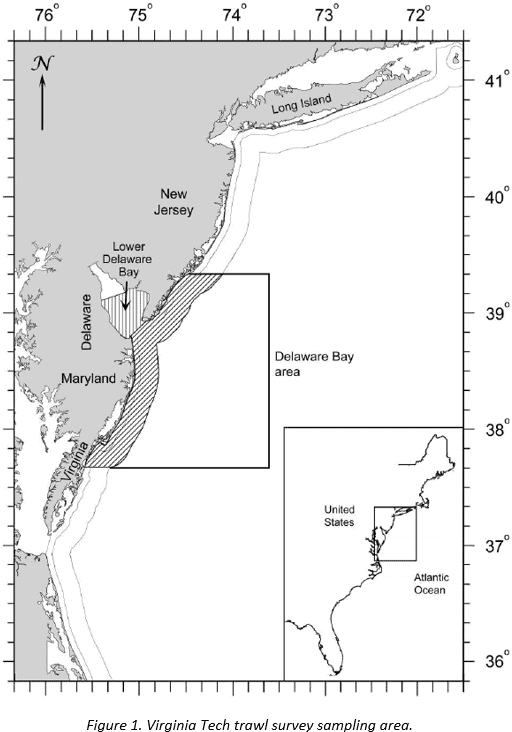
The horseshoe crab trawl survey, which has been administered by Virginia Tech since 2002, is the only survey designed to sample the horseshoe crab population in coastal waters. Its geographic scope is broad, covering the Atlantic coast from Atlantic City, New Jersey to Wachapreague, Virginia and the lower Delaware Bay as funding and time allow (Figure 1). The survey area is divided into nearshore and offshore and into trough and non-trough areas and all sub-areas are sampled randomly. Relative abundance of immature, newly mature, and mature males and females are tracked separately.
Relative abundance data from the horseshoe crab trawl survey are a critical component of the ASMFC’s coastwide horseshoe crab stock assessment and ARM Framework, both of which have been endorsed by repeated rounds of independent peer review since 2009.
Generally supported by congressionally directed funds in the past, the horseshoe crab trawl survey would not have been conducted in 2011 and 2012 were it not for funding support contributed by the biomedical and fishing industries, who depend upon a robust population of horseshoe crabs. The survey was not conducted in 2013 – 2015, due to a lack of funding, but it has resumed with congressional funds for 2016-2026.
Horseshoe Crab/Red Know Connection & the Management of Delaware Bay Horseshoe Crabs Using the ARM Framework
What is the relationship between horseshoe crabs and migratory shorebirds? What does the ASMFC do to manage horseshoe crabs in order to consider the needs of shorebirds?
Horseshoe crab eggs play an important ecological role in the food web for migrating shorebirds, including the red knot, a threatened species under the Endangered Species Act. The Delaware Bay Estuary is the largest staging area for shorebirds along the Atlantic Flyway. Hundreds of thousands of migratory shorebirds converge on Delaware Bay to feed and rebuild energy reserves prior to completing their northward migration. Since the early 1990s, the number of shorebirds in Delaware Bay has generally declined.
ASMFC developed the ARM Framework to account for the needs of shorebirds and the horseshoe crab population when setting bait harvest quotas in the Delaware Bay region. The output of the ARM Framework has been used to inform the setting of harvest levels since 2013. Development of the model was done collaboratively with red knot and horseshoe crab scientists from the United States Geological Survey (USGS), US Fish and Wildlife Service (USFWS), academia, and state agencies. Underlying the ARM Framework are integrated population models for both red knots and horseshoe crabs. The model uses red knot abundance estimates provided by the Delaware Bay Shorebird Project, conducted by state and federal shorebird scientists, and horseshoe crab population estimates derived from three trawl surveys conducted by Virginia Tech, Delaware, and New Jersey. Typically, the ARM model is used annually to recommend the optimum harvest levels for the following year given the current year’s estimate of horseshoe crab and red knot abundance, with the objective of maximizing horseshoe crab harvest while maintaining ecosystem integrity and adequate stopover habitat for migrating shorebirds over the long-term. The maximum harvest levels for males and females are 500,000 and 210,000, respectively. Since the implementation of the ARM model, the Horseshoe Crab Management Board has restricted bait harvest in the Delaware Bay region to 500,000 male-only crabs which gets allocated between New Jersey, Delaware, Maryland, and Virginia. Although total harvest is allocated among Delaware Bay region states, New Jersey has prohibited commercial harvest of horseshoe crabs for bait in state waters since 2006. Female harvest has not been implemented in the region since the ARM Framework was adopted in 2012.
The ARM Framework underwent a revision in 2021 to update the model platform and incorporate new sources of data. The 2021 Revision includes improvements to the ARM Framework’s population models for horseshoe crabs and red knots and incorporates more sources of horseshoe crab removal data, including mortality due to commercial discards (i.e., bycatch) from other fisheries and the biomedical industry. Given these improvements, which address previous peer review critiques, the ARM Revision was endorsed by the independent peer review panel as the best scientific information for the management of horseshoe crabs in the Delaware Bay Region that accounts for the forage needs of migratory shorebirds. An overview of the ARM Revision can be found here.
After accepting the ARM Revision and Peer Review for management use in January 2022, the Board approved Addendum VIII in November 2022 to allow its use in setting annual specifications for horseshoe crabs of Delaware Bay-origin.
Why does the ARM Framework allow for female horseshoe crab harvest when concerns remain that the red knot population is threatened by a shortage of crab eggs?
The ARM Framework uses projections to estimate how population dynamics will respond to given harvest levels over time and determine what harvest levels are likely to result in a sustainable horseshoe crab population large enough to support shorebirds into the future. Given the large population of horseshoe crabs in the Delaware Bay Region, in recent years, the ARM Framework has determined that a limited amount of female horseshoe crab harvest is unlikely to negatively impact red knot populations or slow their recovery.
At this time, the ARM Framework is not able to incorporate egg density data into the models to inform optimal horseshoe crab harvest levels, primarily because the data were not provided for evaluation during the 2021 ARM Revision. However, a research recommendation was made to examine the relationship between egg density estimates and horseshoe crab abundance estimates. Although egg density is an important indicator of spawning activity, it varies substantially among beaches, tides, and sampling conditions, and a clear relationship between egg density and female horseshoe crab abundance has not been identified. This complicates efforts to link horseshoe crab abundance to red knot survival through egg density in the ARM Framework.
Additionally, crab egg availability is not the only potential limiting factor for the red knot population. In addition to reduced prey availability (i.e., fewer horseshoe crab eggs), the 2014 final listing rule and 5-Year Review (2021) determined that many other primary threats are also driving the red knot status, including: loss of breeding and nonbreeding habitat (from sea level rise, coastal engineering, coastal development, and Arctic ecosystem change); disruption of natural predator cycles on breeding grounds; and increasing frequency and severity of mismatches in the timing of the birds’ annual migratory cycle relative to favorable food and weather conditions. These threats and their impacts on the red knot population may at least partially explain why the red knot population has not recovered while horseshoe crab abundance and egg densities in Delaware Bay have increased over the years the ARM Framework has been implemented.
USFWS evaluated the changes to management of horseshoe crabs under the ARM Revision to determine the likelihood of impacts to red knots. The analysis estimated that there is a less than one percent chance of a red knot population decline at the levels of female harvest allowed under the ARM Revision. Based on this analysis, USFWS concluded that take, defined under the Endangered Species Act as killing or harming of red knots, is not likely. More information on the USFWS analysis of the ARM Framework Revision is available here.
When will the ARM Framework be updated again?
During the 2021 ARM Framework revision, the ARM Subcommittee recommended the model parameters for both species be updated in five years or less, and another benchmark assessment and model evaluation be considered in 10 years. An update to the model parameters is expected in 2027. An ARM benchmark has not been scheduled but will be conducted after the 2029 coastwide benchmark stock assessment.
Additionally, in 2026 a stakeholder engagement process was conducted to inform possible changes to the ARM Framework components that reflect stakeholder values related to red knot recovery levels, the economic value of horseshoe crab bait, and maximum harvest levels. In January 2026, a two-day workshop was held with 14 stakeholders representing six groups with interests in horseshoe crab harvest management in Delaware Bay: bait harvesters and dealers, the biomedical industry, ecosystem conservation organizations, horseshoe crab conservation organizations, and shorebird conservation scientists and organizations. Through this process the participants produced several recommendations to update the core values-based components of the ARM Framework. The Horseshoe Crab Management Board considered the final stakeholder process report in May 2026 and tasked the ARM Subcommittee with developing the recommended model updates. In November 2026, the Board will review the updates and consider implementing the changes to the management program through an addendum to the FMP.
Biomedical Uses
Do ASMFC quotas apply to the biomedical industry?
No, the FMP established state-by-state quotas for the horseshoe crab bait fishery only. At this time, the FMP does not provide for establishment of quotas on horseshoe crabs taken specifically for the biomedical industry. However, the states are required to report all biomedical data to ASMFC, including number of male and female crabs collected, bled, and released annually. Some states, such as Massachusetts, have established specific quotas for horseshoe crabs collected for biomedical purposes.
Does the ASMFC manage the biomedical industry?
It is an FMP requirement that horseshoe crabs harvested for biomedical purposes be released alive into the waters they were collected. ASMFC also requires states where biomedical facilities operate to report biomedical harvest and release data and works to incorporate those data into the assessment of the species. Additionally, ASMFC and the biomedical industry collaboratively developed Best Management Practices (BMPs) for handling biomedical horseshoe crabs in a way that maximizes their survival. States with biomedical harvest have incorporated the BMPs into their regulations, permit conditions, or guidelines for facilities to follow.
How many horseshoe crabs are collected solely for biomedical purposes each year?
ASMFC has been collecting data from biomedical facilities since 2004. This information includes the number of live crabs collected, number of live crabs bled, how many crabs died during the process, and how many were released alive. In 2024, 1,008,943 horseshoe crabs were bled by the biomedical facilities coastwide, not including crabs from the bait fishery. To account for crabs that may die after bleeding, an estimated 15% post-bleeding mortality rate applied to the number of bled horseshoe crabs. This mortality rate is based on a comprehensive analysis of peer-reviewed studies on post-bleeding biomedical mortality, completed during the 2019 stock assessment. Total estimated mortality from the biomedical process is the sum of the number of observed mortalities (pre-release) and the 15% estimated post-release mortality. In 2024, the total estimated biomedical mortality was 184,693 horseshoe crabs.
Biomedical harvest and mortality from 2004-2024 can be found on the horseshoe crab webpage and in the most recent Fishery Management Plan Review.
Why are biomedical data confidential?
While ASMFC has comprehensive data about the biomedical harvest and use of horseshoe crabs at each facility, the data are confidential and cannot be published by ASMFC. Federal and state laws prohibit the disclosure of confidential data, and ASMFC abides by those laws. In determining what data are confidential, most agencies use the “rule of three.” The “rule of three” requires three separate contributors to proprietary fisheries data in order for the data to be considered non-confidential. This protects the identity of any individual contributor. For example, if there is only one known harvester of a species in a state, the harvester’s identity is implicit and therefore that state’s data for the species are confidential. Federal data confidentiality provisions are outlined as part of the Magnuson-Stevens Fishery Conservation and Management Reauthorization Act.
The biomedical industry does provide the ASMFC, through state agencies, data regarding the harvest, bleeding, and release of horseshoe crabs at each facility and these numbers are incorporated into the current stock assessment and reported annually as coastwide totals. In this way, the data are not confidential because at least three facilities’ data are aggregated together so no one facility’s harvesting activities can be identified. Numbers for individual companies or subsets that would allow calculation of individual companies’ numbers are confidential as required by state and federal law.
Prior to the 2019 assessment, biomedical data were not included in the modeling efforts as a source of mortality. For the 2019 and 2024 stock assessments, the Horseshoe Crab Stock Assessment Subcommittee was granted access to the confidential biomedical data so it could be used in statistical models for assessing the population of horseshoe crabs. However, in accordance with state and federal law, confidential data could not be included in the public stock assessment reports.
Are there “horseshoe crab free” alternatives to using LAL for testing? What about the so called “synthetic” product(s)?
LAL serves two primary purposes: Bacterial Endotoxin Testing (BET) and clinical/medical diagnostics. BET is the most widely known use of LAL. Endotoxins are components of some types of bacteria that become dangerous when they cross the blood wall. Testing for endotoxins is mandated by the US Food and Drug Administration (FDA) and health care regulators around the world for a variety of drugs and implantable devices that come into contact with human blood or spinal fluid, for example, vaccines, IVs, dialysis solutions, insulin, GLP-1 drugs, hip replacements, stents, pacemakers, etc. Millions of LAL based endotoxin tests are performed annually around the globe, and it has been the standard test type for over 50 years.
There are only four FDA-licensed manufacturers of LAL in the US, and each one has a recombinant DNA technology (synthetic) product used for BET: Recombinant factor “C” (rFC) and Recombinant Cascade Reagent (rCR). Both of these alternatives are based on cloning factors of the horseshoe crab blood, rather than chemical synthesis such as in the making of aspirin. Compared to LAL endotoxin tests, these alternative BET products have limitations in application and global regulatory acceptance.
LAL is also used to help diagnose invasive fungal infections, which are severe, life-threatening medical conditions that occur when fungi enter a patient’s bloodstream or internal organs. There is no synthetic replacement for LAL based assays used in the diagnosis of invasive fungal infections.
More information on this topic can be found in the United States Pharmacopeia FAQ and the FDA guidance for alternative endotoxin testing.
Resources
- State by State Quotas
- 2024 Stock Assessment Update
- Overview of 2024 Stock Assessment Update
- FMP Review for the 2024 Fishing Year
- 2021 Revision to the Adaptive Resource Management Framework and Peer Review Report
- USFWS Analysis of the ARM Framework Revision
- Addendum VII to the Interstate FMP
- 2026 Stakeholder Engagement Process Report
- Best Management Practices for Handling Horseshoe Crabs for Biomedical Purposes
- FDA guidance for alternative endotoxin testing
- United States Pharmacopeia FAQ
Questions about ASMFC’s Fact Check Policy?
ASMFC strives for transparency by ensuring that its decision-making processes are open and accessible to the public. This includes holding public meetings, providing opportunities for public comment, and making detailed information, such as meeting agendas, minutes, and reports, readily available on their website. The Commission also engages stakeholders through advisory panels, public hearings, and webinars, and consistently updates the public on management decisions and scientific findings. By maintaining clear communication and involving the public at every stage, ASMFC promotes accountability and trust in its fisheries management efforts.