
2025 Annual Meeting Outcomes
There’s been a lot of stakeholder discussion on the outcome of the October 28, 2025 meeting of the Atlantic Menhaden Management Board. Some of the information being shared reflects a misunderstanding of the findings of the single-species assessment update and Ecological Reference Point Benchmark Stock Assessment, as well as the Board’s response to the assessments’ findings. In addition to these FAQs, the stock assessment overview is also an excellent resource. It can be found here.
Has the menhaden population really declined by 37% between 2021 and 2024?
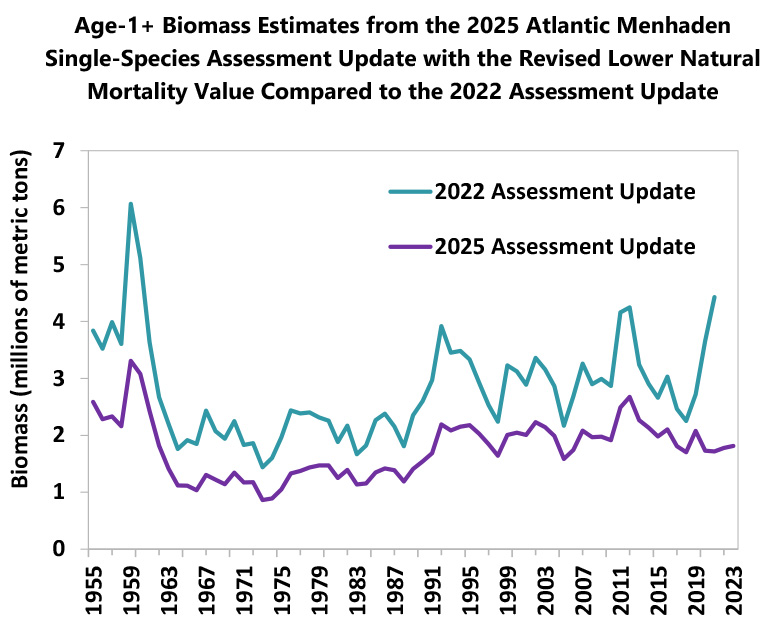
The difference in the population estimates from the 2022 and 2025 assessments is primarily due to a change in the estimate of natural mortality, which affects our estimates of the overall size of the stock. From the figure below, we can see that the estimates of menhaden biomass from the 2025 assessment update are lower in every year compared to the estimates from the 2022 assessment. The average menhaden biomass over the whole time-series from the 2025 assessment update is 37% lower than the average biomass from the 2022 update. However, the 2025 update indicates total biomass has actually slightly increased since 2021. The lower estimate of biomass from the current assessment compared to the previous assessment is a result of a change in our understanding of the stock rather than a change in the stock itself.
Why is the estimate for natural mortality lower than in previous stock assessments?
Natural mortality in the single-species model is based on a large-scale tagging study that occurred in the late 1960s. A published paper was done on this by Liljestrand et al. in 2019, and the estimate from that study was used to inform the estimate of natural mortality used in the 2020 single-species and ERP benchmark assessments, and the 2022 single-species assessment update. During the 2025 ERP benchmark assessment, scientists from the University of Miami presented to the Stock Assessment Subcommittee (SAS) a reanalysis of the tagging data that resulted in a lower estimate than Liljestrand et al. had found in their paper. The SAS formed a work group to review the data and the analyses and consult with the authors of both papers to understand what was causing the differences and determine the best estimate of natural mortality to use in the single-species model.
After the Work Group looked at these two papers, they realized that different subsets of the data had been used. There were issues with confidential versus nonconfidential data being used, and there were different ways of estimating the efficiency of the magnets that recover the tags, including an error in the Liljestrand et al. estimate of that efficiency. A more detailed explanation of this issue can be found in a presentation to the Board at https://youtu.be/Z7yK8ZwhWMo.
The Work Group chose the most appropriate dataset, corrected the magnet efficiency error, and developed a new estimate for natural mortality that was about 20% lower than the previous Liljestrand et al. estimate. The revised estimate of natural mortality was peer-reviewed through SEDAR 102, as part of the ERP Benchmark Assessment.
If natural mortality is lower than we thought before, why is the population smaller?
Essentially, the natural mortality rate affects the scale of the population but does not alter the trends over time. The stock assessment model estimates the size of the menhaden population based on the biology of the species, including our understanding of the natural mortality rate, and observed data like how many fish are caught in commercial and recreational fisheries, as well as in fishery-independent surveys, and what the trends are over time. If natural mortality is very high (many fish are lost to natural causes like predation, disease, and other factors), the overall population must be very large to account for those losses and still produce the catch and survey data that we see. But if natural mortality is lower (fewer fish are dying due to natural causes), the stock does not need to be as large to produce the observed data.
If fishing mortality is currently between the ERP threshold and ERP target, is overfishing occurring?
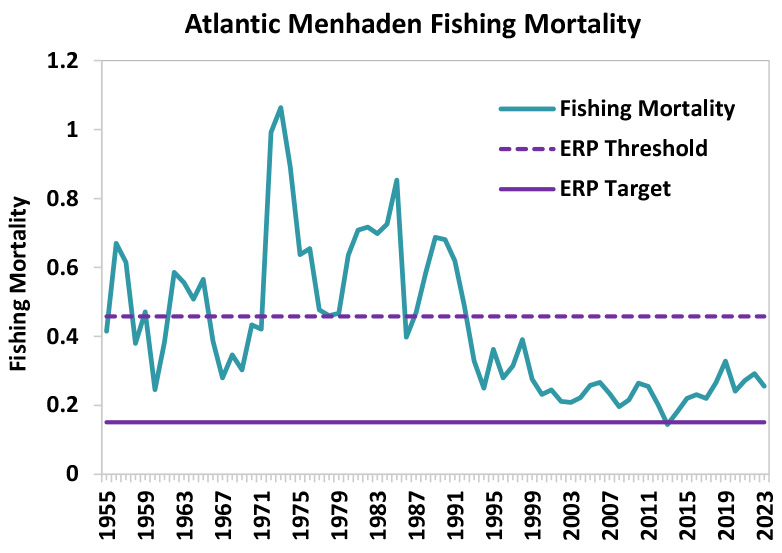
Menhaden is not experiencing overfishing, because fishing mortality was below the ERP fishing mortality threshold at the end of the assessment. In the Atlantic Menhaden FMP, the Board, with input from the Technical Committee and ERP Work Group, defined both a threshold and a target for fishing mortality. The fishing mortality threshold is used to determine stock status: when fishing mortality is higher than the fishing mortality threshold, overfishing is occurring and the FMP directs the Board to take action to end overfishing. The lower fishing mortality target serves as an additional buffer against overfishing, and the Board sets regulations, including the TAC, with the goal of achieving the target, not the threshold. However, if fishing mortality is above the target but below the threshold, there is still no danger to the menhaden stock itself, since the ERPs are more conservative than the single-species reference points. In addition, our ecosystem models indicate that fishing between the ERP target and the ERP threshold will not cause striped bass to be overfished. The Board took a 20% reduction to the coastwide total allowable catch to achieve a zero percent probability of exceeding the ERP threshold and to bring management closer to the target than the previous TAC.
Why did the Board only take a 20% cut in total allowable catch when projections suggested that it should have been closer to 50%?
While projections indicated the 20% cut to the TAC would not be enough to achieve the ERP F target, the projections also showed that it would have a 0% chance of overfishing in 2026. In addition, the ERP model indicates that fishing at this level will not cause striped bass to be overfished. To have a lower probability of being at or above the ERP F target, a 50% or more reduction in the TAC would be required. This represented a significant change from the advice provided during the 2022 assessment update, and both the Board and the public received this information only a short time before the meeting to set the TAC. The Board had concerns about the socioeconomic impact of implementing such a significant cut in a single year on short notice and chose to take a more moderate cut for 2026 only.
This will provide the Board more time to thoroughly consider the new information and further engage with their stakeholders on how best to move forward for 2027 and beyond. This may include a discussion about the current definitions of the ERP threshold and target and whether they are set appropriately to support striped bass rebuilding efforts. Inherent in the setting of these definitions is the understanding that there are tradeoffs between menhaden and striped bass management goals.
Why are Atlantic menhaden an important fish along the Atlantic coast and how is the species managed?
Atlantic menhaden are a crucial forage species in the Atlantic coastal ecosystem, supporting a wide range of predators such as striped bass, bluefish, marine mammals and seabirds. They also support important commercial reduction and bait fisheries.
Due to menhaden’s importance along the Atlantic East Coast, the Commission began coordinating its management with a Fishery Management Plan for Atlantic Menhaden in 1981. Currently, the Commission coordinates the species management under Amendment 3 to the Interstate Fishery Management Plan for Atlantic Menhaden, which seeks to balance the needs of the commercial reduction and bait fisheries with the ecosystem services menhaden provide. More recently, the Commission’s Atlantic Menhaden Management Board approved Addendum I to Amendment 3 in 2022 along with a revised Technical Addendum in 2023, to address commercial allocations, the episodic events set aside program, and incidental catch/small-scale fisheries.
In October 2025, the Board initiated an addendum to consider options to reduce the Chesapeake Bay Reduction Fishery Cap by up to 50% and distribute the cap more evenly throughout the fishing season. The options will aim to alleviate a concentration of effort that may be affecting other fisheries within the Bay and other potential ecological impacts. The Board discussed concerns regarding decreasing pound net harvests and catch per unit effort within the Bay as the timing of reduction fishing effort has changed over the last few years. The Board will review the Draft Addendum in February and will either approve the draft for public comment or provide additional guidance to the Plan Development Team for further development.
What is the status of Atlantic menhaden and does this status apply to every part of its Atlantic coast range?
The Atlantic menhaden stock status evaluated using two assessments: the 2025 single-species assessment update and Ecological Reference Points (ERP) Benchmark Stock Assessment. The use of ERPs was implemented in 2020 to better understand menhaden’s ecosystem roles. The ERP assessment develops target and threshold reference points for menhaden fishing mortality and fecundity, and the single-species assessment determines the most recent mortality and fecundity values to determine if they are within the limits set by the ERPs. Fishing mortality determines if the stock is experiencing overfishing and fecundity determines if the stock is overfished. Currently, Atlantic menhaden is not overfished and overfishing is not occurring. This stock status applies to menhaden’s entire Atlantic coast range, but due to stock assessment methods, no inferences can be made on a smaller regional scale such as the Chesapeake Bay portion of Atlantic menhaden’s range.
Menhaden Fishery
What exactly is the menhaden reduction fishery?
There have been commercial fisheries for Atlantic menhaden since the early 19th century. Today, the fishery is divided into two primary sectors, bait and reduction, which are defined by how the fish is used after it is caught rather than by the gear or means used to catch the fish. For example, some states have prohibited harvesting menhaden for reduction purposes but have bait fisheries that use the same purse seine nets as those used in the reduction fishery. The reduction fishery, named because it “reduces” the whole fish into fish meal, fish oil, and fish solubles, first began in New England during the early 1800s and spread south after the Civil War. The reduction fishery grew with the advent of purse seines in the mid-1800s and reached peak landings in 1956 at 712,100 metric tons (mt). At the time, over 20 menhaden reduction factories ranged from southern Maine to northern Florida.
In the 1960s, the Atlantic menhaden stock contracted geographically, and many of the reduction factories north of the Chesapeake Bay closed due to a scarcity of fish. Consequently, reduction landings dropped to 161,000 mt in 1969. In the 1970s and 1980s, the menhaden population began to expand (primarily due to a series of above average year classes entering the fishery), and reduction landings rose to around 300,000-400,000 mt. Adult menhaden were again abundant in the northern half of their range and, as a result, reduction factories in Canada and New England began processing menhaden again by the mid-1970s. However, by 1989 all shore-side reduction plants in New England had closed, mainly because of odor abatement regulations.
During the 1990s, the Atlantic menhaden stock contracted again, largely due to a series of poor to average year classes. Over the next decade, several reduction plants consolidated or closed, resulting in a significant reduction in fleet size and fishing capacity. By 2006, there was only one remaining reduction plant in operation on the Atlantic coast processing menhaden into fishmeal and oil. This is the Omega Protein plant, located in Reedville, Virginia, which is still operational today. In 2024, roughly 134,400 mt combined landings from the Chesapeake Bay and ocean were used for reduction purposes.
Currently, the menhaden reduction fishery is certified sustainable by the Marine Stewardship Council (MSC), an independent non-profit organization that promotes sustainable fishing practices. Its mission is to use its certification program and blue fish ecolabel to contribute to the health of the world’s oceans ensuring seafood is sourced responsibly.
Why does Virginia get the largest allocation of Atlantic menhaden among the Atlantic coast states?
As in many fisheries, Atlantic menhaden commercial allocations are largely based on landings history. Addendum I to Amendment 3, implemented in 2023, established a new allocation system. There is a three-tiered system for minimum allocations to the states, with Pennsylvania receiving 0.01%; South Carolina, Georgia, Connecticut, Delaware, North Carolina, and Florida receiving 0.25%; and the remaining states continuing to receive a minimum of 0.5%. The remainder of the TAC, excluding the 1% reserved for the Episodic Event Set Aside program, is distributed on a state-by-state basis based on landings history of the fishery from 2018, 2019, and 2021.If you look at the bait and reduction landings graph on the menhaden webpage, you will see the Virginia reduction fishery has been a significant harvester of menhaden since the 1940s, with a number of peaks in landings, and harvested the largest share of menhaden on the coast from 2018-2021. However, recent landings are among the lowest over the past 80 years.
Are there other types of fisheries for menhaden?
While reduction landings have declined since the mid-2000s, menhaden landings for bait have become increasingly important to the total coastwide landings of menhaden. Commercial bait landings occur in almost every Atlantic coast state. A majority of bait landings are used commercially in crab, lobster, and hook-and-line fisheries.
In contrast to reduction landings, bait landings have increased in recent years due to higher demand and increased menhaden availability in the northern part of the species’ range. Total bait landings along the Atlantic coast averaged 44,600 mt from 2005-2012 prior to the implementation of the total allowable catch (TAC) and have averaged 50,000 mt since then. In 2024, bait landings were approximately 52,000 mt and comprised 39% of coastwide landings.
Total commercial landings in 2024 were 186,155 mt, representing a 12% increase in landings from 2023.
For a more detailed summary of the commercial fisheries, go to Amendment 3, starting on page 10.
Ecological Reference Points
How are menhaden’s ecosystem roles accounted for in management?
Atlantic menhaden are a crucial forage species in the Atlantic coastal ecosystem, supporting a wide range of predators including striped bass, bluefish, marine mammals, and sea birds. Given its importance as a forage fish, the Commission and its member states use ecosystem-based approaches (i.e., ecological reference point models) to quantify the effects of Atlantic menhaden harvest on its predators, examine the impact of predators on Atlantic menhaden removal targets, and quantitatively evaluate the tradeoffs between menhaden harvest and predator demand.
What are the Ecological Reference Points (ERPs) and why are they used to inform Atlantic menhaden management?
Traditionally, most fisheries have been assessed and managed on a species-by species basis. However, species do not exist in a single-species vacuum in their natural environments. For example, a fish population is impacted by the availability of food, the level of predation, and the prevailing environmental conditions, among many other factors. In addition, that fish species, in turn, affects its predator and prey species, and the broader ecosystem.
For Atlantic menhaden, by understanding these ecosystem interactions management decisions can be made in a way that accounts for unforeseen impacts elsewhere, including on other fisheries, endangered species, and the ecosystem. Ecosystem-based approaches to fisheries management seek to account for these ecosystem interactions when managing fisheries. In August 2020, the Commission’s Atlantic Menhaden Board took a major step towards an ecosystem approach to fisheries management by approving the use of ecological reference points (ERPs) for the management of menhaden. The ERPs will allow the Board to account for the species’ role as a crucial forage fish.
The current base ERP model uses an Ecopath with Ecosim model called the Northwest Atlantic Coastal Shelf Model of Intermediate Complexity or the NWACS-MICE model. This model was chosen because it can incorporate both the effects of predators on the menhaden population and the effects of menhaden on predator populations, it’s easier to update than other models, and accounts for species that are more sensitive to Atlantic menhaden harvest. This model was peer reviewed and approved by the SouthEast Data, Assessment & Review process (SEDAR 102).
How does the ERP assessment incorporate striped bass in its evaluation of menhaden?
Menhaden populations are impacted by the availability of food, the level of predation, and the prevailing environmental conditions, among many other factors. In addition, menhaden, in turn, affects its predator and prey species, and the broader ecosystem. It is essential to understand these ecosystem interactions because management decisions for menhaden could have unforeseen impacts elsewhere, including on other fisheries and the ecosystem. Ecosystem-based approaches to fisheries management seek to account for these ecosystem interactions when managing fisheries through defining ecological reference points for management. The Ecological Reference Point model looks at the relationship between striped bass fishing, striped bass population trends, striped bass forage needs, and the abundance of menhaden to evaluate the relative impact of striped bass fishing and menhaden fishing on striped bass population levels. At the coastwide level, ERP model results show that even if all menhaden fishing suddenly ended, this action alone would not rebuild striped bass to their biomass target. Instead, the important factor for striped bass management is ensuring a sustainable level of recreational and commercial striped bass fishing.
How are osprey considered in the ERP assessment?
For the 2025 ERP assessment, the ERP WG reviewed and updated all available sources of data on osprey population trends and diets. Although the data were limited, the ERP WG included osprey as a predator in the full ecosystem model that was developed to support the intermediate complexity model used for management. The full ecosystem model showed that striped bass and osprey were two of the most sensitive species to menhaden fishing. The ERPs used in management are designed around striped bass, so an ERP target and threshold that would provide adequate forage for striped bass would likely not cause declines for other predators in the ecosystem, including osprey.
Chesapeake Bay
How does ASMFC monitor the populations of menhaden and their predator species in Chesapeake Bay?
The Commission does not directly conduct fishery-dependent or fishery-independent monitoring for any species. Instead, it relies on state and federal partners and academic researchers to provide those data. For menhaden, this includes weekly reporting of reduction fishery landings from the Bay, monthly or trip-level reporting of commercial and recreational bait landings from the Bay, and multiple fishery-independent surveys that provide information on trends in abundance for young-of-year and adult menhaden within the Bay, from both Maryland and Virginia. Fishery-independent surveys, which include unbiased data on the menhaden fishery, are incorporated into the single-species stock assessments, which are updated every three years.
For other species, including osprey and other piscivorous birds, such data can be provided to the Commission for consideration by the Atlantic Menhaden Management Board. For example, at the Commission’s 2024 Summer Meeting, researchers from the US Geological Survey provided a report on osprey data in Chesapeake Bay to the Atlantic Menhaden Management Board.
What assurance checks are in place to ensure there is sufficient menhaden in Chesapeake Bay at any given time and how was Chesapeake Bay harvest limit of 51,000 mt established?
The Chesapeake Bay cap was first established in 2006 as a precautionary measure in response to concerns about localized depletion and set at the average landings from 2001-2005 (or 109,020 mt) through Addendum III to Amendment 1. The cap was set through adaptive management, as defined in Amendment 3 (see PDF page 49).
Amendment 2, implemented in 2012, reduced the cap by 20% to 87,216 mt, and Amendment 3, implemented in 2018, further reduced the cap to its current level of 51,000 mt, which represents an approximation of the average Bay reduction landings from 2012-2016. Although the overall coastwide quota increased for 2023-2025 based on the 2022 stock assessment update, the Board maintained the Bay cap at 51,000 mt.
While the Bay cap is based on historical landings, the coastwide stock assessment includes information from fishery-dependent and fishery-independent surveys within and outside the Bay. Currently, the model used to establish the overall quota for menhaden is a coastwide model; it allows the Commission to provide the Atlantic Menhaden Management Board with the necessary data to set reference points and harvest levels that account for menhaden’s role as a forage fish at the coastwide level. However, as the stock assessment model is designed to be coastwide, it cannot provide information on the abundance of menhaden solely in Chesapeake Bay or what is a “sufficient” level of menhaden in the Bay.
Is it possible that industrial harvest in Chesapeake Bay is damaging an important menhaden nursery and affecting populations of dependent species including osprey, striped bass and weakfish?
Atlantic menhaden are currently managed and assessed as a coastwide stock. The assessment uses data on menhaden and their key predators from both Chesapeake Bay and coastal ocean waters to evaluate the health of the stock and the ecosystem as a whole. However, our models currently cannot provide stock status for smaller regions, and so while we recognize that the dynamics in Chesapeake Bay may be different from the overall average dynamics, we cannot provide quantitative advice about harvest for the Bay and the ocean separately. The development of models and data that can address finer spatial scales is a research priority for the species. The current stock assessment (completed in 2025) still evaluates menhaden as a coastwide stock but begins to explore methods and data that could be used in the next assessment to determine stock status on a finer spatial scale.
There are numerous potential factors responsible for declines in other species that cannot be ruled out. Under the current ecological reference points (ERPs), which were developed to account for menhaden’s role as a forage species, the stock is not overfished, nor is it experiencing overfishing on a coastwide basis.
Is Atlantic Menhaden Management Board considering reducing the Chesapeake Bay Cap?
In October 2025, the Atlantic Menhaden Management Board initiated an addendum to Amendment 3 to consider options to reduce the Chesapeake Bay Reduction Fishery Cap by up to 50% and distribute the cap more evenly throughout the fishing season. The options will aim to alleviate a concentration of effort that may be affecting other fisheries within the Bay and other potential ecological impacts. The Board discussed concerns regarding decreasing pound net harvests and catch per unit effort within the Bay as the timing of reduction fishing effort has changed over the last few years. The Board will review the Draft Addendum in February and will either approve the draft for public comment or provide additional guidance to the Plan Development Team for further development.
Questions about ASMFC’s Fact Check Policy?
ASMFC strives for transparency by ensuring that its decision-making processes are open and accessible to the public. This includes holding public meetings, providing opportunities for public comment, and making detailed information, such as meeting agendas, minutes, and reports, readily available on their website. The Commission also engages stakeholders through advisory panels, public hearings, and webinars, and consistently updates the public on management decisions and scientific findings. By maintaining clear communication and involving the public at every stage, ASMFC promotes accountability and trust in its fisheries management efforts.