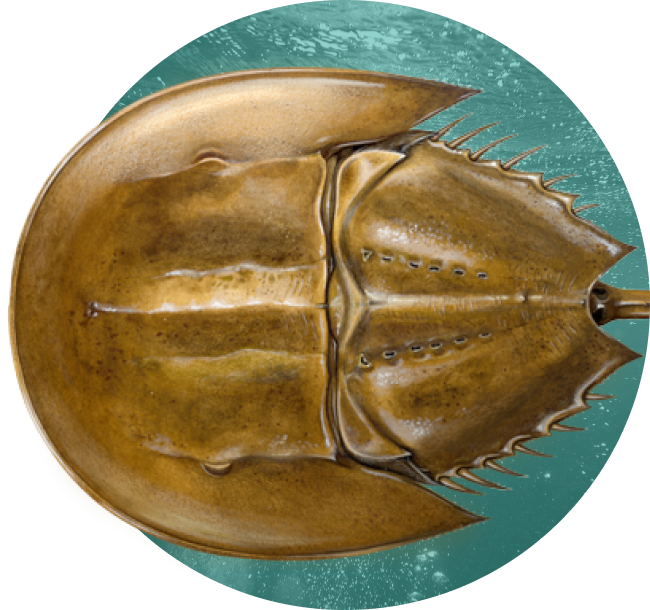
The Commission’s Horseshoe Crab Management Board approved the harvest specifications for horseshoe crabs of Delaware Bay origin. Under the Adaptive Resource Management (ARM) Framework, the Board set a harvest limit of 500,000 Delaware Bay male horseshoe crabs and zero female horseshoe crabs for the 2021 season. Based on the allocation mechanism established in Addendum VII, the following quotas were set for the States of New Jersey, Delaware, and Maryland and the Commonwealth of Virginia, which harvest horseshoe crabs of Delaware Bay origin:
| 2021 Delaware Bay Origin Horseshoe Crab Quota (no. of crabs) | 2021 Total Quota** | |
| State | Male Only | Male Only |
| Delaware | 162,136 | 162,136 |
| New Jersey | 162,136 | 162,136 |
| Maryland | 141,112 | 255,980 |
| Virginia* | 34,615 | 81,331 |
*Virginia harvest refers to harvest east of the COLREGS line only
** Total male harvest includes crabs which are not of Delaware Bay origin.
The Board chose a harvest package based on the Delaware Bay Ecosystem Technical Committee’s and ARM Subcommittee’s recommendation. The ARM Framework, established through Addendum VII, incorporates both shorebird and horseshoe crab abundance levels to set optimized harvest levels for horseshoe crabs of Delaware Bay origin. The horseshoe crab abundance estimate was based on data from the Benthic Trawl Survey conducted by Virginia Polytechnic Institute (Virginia Tech). This survey, which is the primary data source for assessing Delaware Bay horseshoe crab abundance, does not have a consistent funding source. Members of the Delaware and New Jersey U.S. Congressional Delegations, with the support of NOAA Fisheries, have provided annual funding for the survey since 2016.
For more information, please contact Caitlin Starks, Fishery Management Plan Coordinator, at 703.842.0740 or cstarks@asmfc.org.