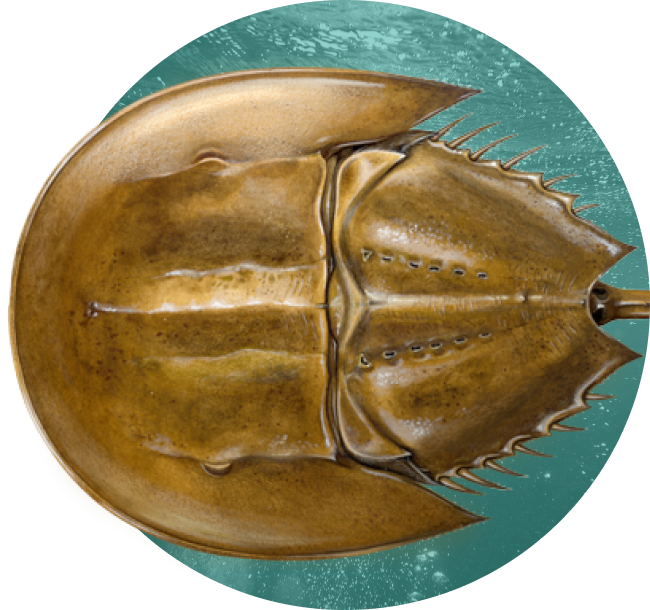
Bar Harbor, ME – The Commission’s Horseshoe Crab Management Board approved the harvest specifications for horseshoe crabs of Delaware Bay origin. Under the Adaptive Resource Management (ARM) Framework, the Board set a harvest limit of 500,000 Delaware Bay male horseshoe crabs and zero female horseshoe crabs for the 2017 season. Based on the allocation mechanism established in Addendum VII, the following quotas were set for the states of New Jersey, Delaware, Maryland and Virginia, which harvest horseshoe crabs of Delaware Bay origin:
| Delaware Bay Origin Horseshoe Crab Quota (no. of crabs) | Total Quota** | |
| State | Male Only | Male Only |
| Delaware | 162,136 | 162,136 |
| New Jersey | 162,136 | 162,136 |
| Maryland | 141,112 | 255,980 |
| Virginia* | 34,615 | 81,331 |
*Virginia harvest refers to harvest east of the COLREGS line only
** Total male harvest includes crabs which are not of Delaware Bay origin.
The Board chose a harvest package based on the Technical Committee and ARM Subcommittee recommendation. The ARM Framework, established through Addendum VII, incorporates both shorebird and horseshoe crab abundance levels to set optimized harvest levels for horseshoe crabs of Delaware Bay origin. Previously, the horseshoe crab abundance estimate was based on data from the Benthic Trawl Survey conducted by Virginia Polytechnic Institute. However, due to a lack of funding, the Benthic Trawl Survey has not been conducted in recent years. Therefore, a composite index of the Delaware Trawl Survey, New Jersey Delaware Bay Trawl Survey, and New Jersey Ocean Trawl Survey was used instead. The Benthic Trawl Survey has been funded for 2016 and is currently underway. Funding for future years is being explored.
Given the upcoming benchmark stock assessment in 2018 and the potential for management changes resulting from the assessment, the Board postponed any further action of Draft Addendum VIII until after the assessment and peer review. In preparation for the assessment, the Horseshoe Crab Technical Committee, Delaware Bay Ecosystem Technical Committee, and the ARM Subcommittee emphasized the need for information on sex‐specific mortality of horseshoe crabs from the time of collection to release by biomedical bleeding facilities. Further, the committees recommended the states conduct surveys of eel and whelk fishermen to gain information on current baiting practices for these fisheries. The states agreed to work on both issues with its biomedical industries and fishermen. Results of these surveys are expected to be made available to the Board in May 2017.
For more information, please contact Michael Schmidtke, FMP Coordinator, at 703.842.0740 or mschmidtke@asmfc.org.