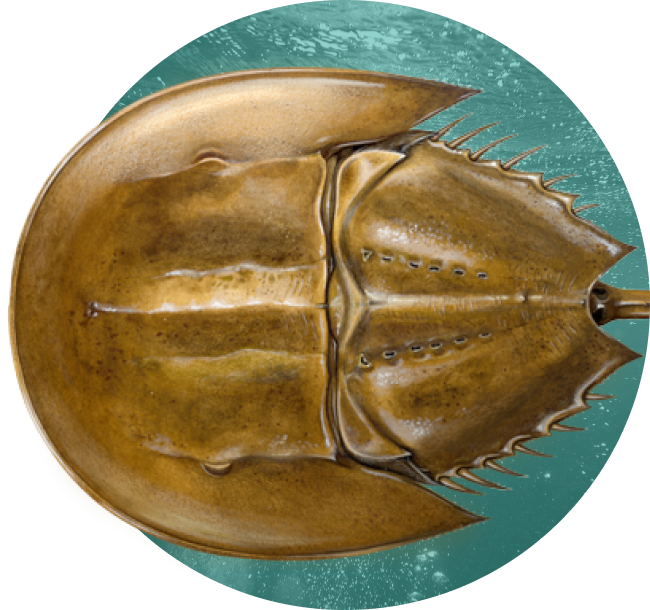
Arlington, VA – The Commission’s Horseshoe Crab Management Board reviewed and approved Draft Addendum VIII for public comment. Draft Addendum VIII considers adopting the changes to the Adaptive Resource Management (ARM) Framework recommended in the 2021 ARM Framework Revision and allowing its use in setting annual bait harvest specifications for horseshoe crabs of Delaware Bay-origin.
The Board initiated Draft Addendum VIII in January 2022, after it accepted the 2021 ARM Framework Revision and Peer Review Report for management use. The ARM Revision was endorsed by the independent peer review panel as the best and most current scientific information for the management of horseshoe crabs in the Delaware Bay region, as it addresses previous peer review critiques, includes new sources of data, and adopts new modeling software to set harvest levels for Delaware Bay-origin horseshoe crabs that account for the forage needs of migratory shorebirds.
“The ARM Framework Revision is a necessary and important improvement to the original ARM Framework, which was no longer operational given its obsolete programming,” stated Board Chair John Clark of Delaware. “Like the original ARM Framework, its output provides options for both male and female horseshoe crab harvest based on the abundance levels of horseshoe crabs of Delaware Bay-origin and red knots. Consistent with the Commission’s specification setting for all ASMFC species, the Board, as well as the individual states, have the prerogative to choose more conservative harvest strategies than those provided by the species technical committee or, in this case, the ARM Framework Revision. ”
Since 2013, horseshoe crabs in the Delaware Bay Region (New Jersey, Delaware, Maryland, and Virginia) have been managed under the ARM Framework to set harvest levels with consideration of the needs of migratory shorebirds. The ARM was developed jointly by the Commission, U.S. Fish and Wildlife Service, and U.S. Geological Survey in recognition of the importance of horseshoe crab eggs to migratory shorebirds stopping over in the Delaware Bay region. In particular, horseshoe crab eggs are a critical food source for the rufa red knot, which is listed as threatened under the Endangered Species Act. The 2021 Revision includes improvements to the ARM Framework’s population models for horseshoe crabs and red knots and incorporates more sources of horseshoe crab removal data, including mortality due to the biomedical industry and commercial discards from other fisheries.
Draft Addendum VIII includes two proposed options: no action and an option to adopt the changes to the ARM Framework recommended in the 2021 Revision for use in setting annual bait harvest specifications for horseshoe crabs of Delaware Bay-origin. The changes proposed include using sex-specific harvest recommendations on a continuous scale rather than the previous discrete harvest packages, slight modifications to the adaptive management cycle, revised proportions of each state’s harvest that is of Delaware Bay-origin, and the resulting state allocations. The maximum amount of male and female horseshoe crab harvest (210,000 females and 500,000 males), the general structure of how the ARM optimal harvest output is allocated among the four Delaware bay states, and the conceptual model of horseshoe crab abundance influencing red knot survival and reproduction remain the same in the ARM Revision, with the intent of ensuring the abundance of horseshoe crabs does not become a limiting factor in the population growth of red knots. If no action is taken, management measures would revert back to the provisions of Addendum VI.
The Board recognizes there is considerable public concern about the potential impact of the ARM Revision on the status of the threatened red knot and is committed to fully evaluating its possible use in setting harvest levels for horseshoe crabs of Delaware Bay-origin through the public comment process. A press release will follow with details on the public hearing schedule and how to submit written comments. The Board will meet to review submitted comment and consider final action on the addendum at its next meeting.
A more detailed overview of the 2021 ARM Revision can be found here. The final ARM Revision and Peer Review Report is available here. For more information, please contact Caitlin Starks, Fishery Management Coordinator, at cstarks@asmfc.org or 703.842.0740.