
Dewey Beach, DE – The Commission’s Atlantic Menhaden Management Board received the results of the single-species assessment update and the 2025 Ecological Reference Points (ERPs) Assessment and Peer Review Reports and accepted the ERPs Assessment and Peer Review Report for management use. The goal of the ERPs is to maximize Atlantic menhaden fishing mortality while also accounting for the forage demands of Atlantic striped bass. Atlantic striped bass was the focal species for the reference points because it was the most sensitive predator fish species to Atlantic menhaden harvest in the NWACS-MICE model, so an ERP target and threshold that would provide adequate forage for striped bass would likely not cause declines for other predators in the model. The single-species assessment indicates the stock is not overfished nor experiencing overfishing relative to the ERPs developed through the benchmark assessment.
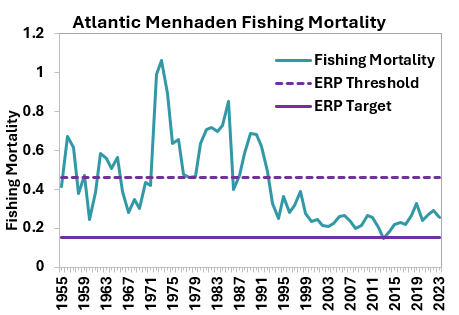
However, fishing mortality (F) was above the ERP F target and fecundity (a measure of the number of eggs the stock can produce in a year) was below the ERP fecundity target. Therefore, the Board set the 2026 total allowable catch (TAC) at 186,840 mt, a 20% decrease from the 2023-2025 TAC of 233,550 mt. Projections indicated this TAC would have a 0% chance of overfishing in 2026 but would still result in a 100% probability of fishing mortality being above the ERP F target. To have a lower probability of being at or above the ERP F target, a 50% or more reduction in the TAC would be required. The Board expressed concerns about the socioeconomic impact of implementing such a significant cut in a single year and chose to take a more moderate cut for 2026 only. This change will provide the Board time to conduct outreach on the results of this new assessment and receive more input from stakeholders before considering a TAC for 2027-2029 at the 2026 Annual Meeting.
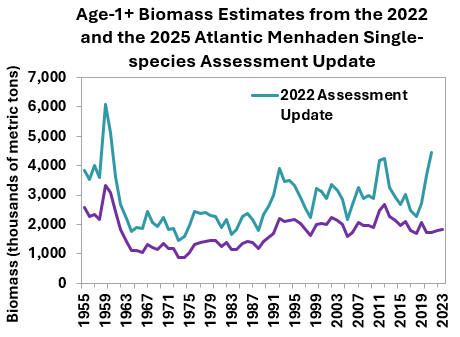
The need for reduction to achieve the ERP F target is due primarily to the change in the estimate of natural mortality used in the single-species stock assessment update, and secondarily to the lower values for the ERPs as a result of the updated and refined ERP model from the benchmark. The 2025 single-species assessment used a revised value of natural mortality that was lower than the value used in the 2020 benchmark and 2022 update. Natural mortality is the rate at which fish die from causes other than fishing; for menhaden, this includes things like predation, disease, and die-offs caused by low oxygen and warm water. This change was reviewed as part of the 2025 ERP Benchmark Assessment, and the Peer Review Panel agreed it represented the best available scientific information on natural mortality for Atlantic menhaden. Using a lower value of natural mortality in the stock assessment results in a lower overall estimate of population size. When a high estimate of natural mortality is used, the model estimates the population needs to be very large to produce the catches and the trends in observed indices. But, if natural mortality is lower, it means fewer fish are dying due to natural causes, meaning the stock does not need to be as large to produce the observed data.
This lower overall estimate of menhaden abundance was also used in the ecosystem models to establish the ERPs. This change, combined with updating estimates of predator (striped bass, bluefish, weakfish, and spiny dogfish) population sizes and diet data as well as refining the ecosystem model structure resulted in lower estimates of the ERP F target and threshold. The ERP assessment, which was endorsed by an independent panel of fisheries scientists, used the Northwest Atlantic Coastal Shelf Model of Intermediate Complexity for Ecosystems (NWACS-MICE) to develop Atlantic menhaden ERPs. The model was chosen because of its ability to explore both the impacts of predators on menhaden biomass and the effects of menhaden harvest on predator populations.
The Board also initiated an addendum to Amendment 3 to consider options to reduce the Chesapeake Bay Reduction Fishery Cap by up to 50% and distribute the cap more evenly throughout the fishing season. The options will aim to alleviate a concentration of effort that may be affecting other fisheries within the Bay and other potential ecological impacts. The Board discussed concerns regarding decreasing pound net harvests and catch per unit effort within the Bay as the timing of reduction fishing effort has changed the last few years. Amendment 3 currently caps reduction harvest within the Bay at 51,000 mt per year. The Board will review the Draft Addendum in February to consider the draft for public comment or provide additional guidance to the Plan Development Team for further development.
The Assessment Update, the Benchmark ERP Stock Assessment, Peer Review Report, and an overview of will be available on the Atlantic Menhaden webpage at https://asmfc.org/species/atlantic-menhaden/ under News and Resources. For more information, please contact James Boyle, Fishery Management Plan Coordinator, at jboyle@asmfc.org or 703.842.0740.
###